
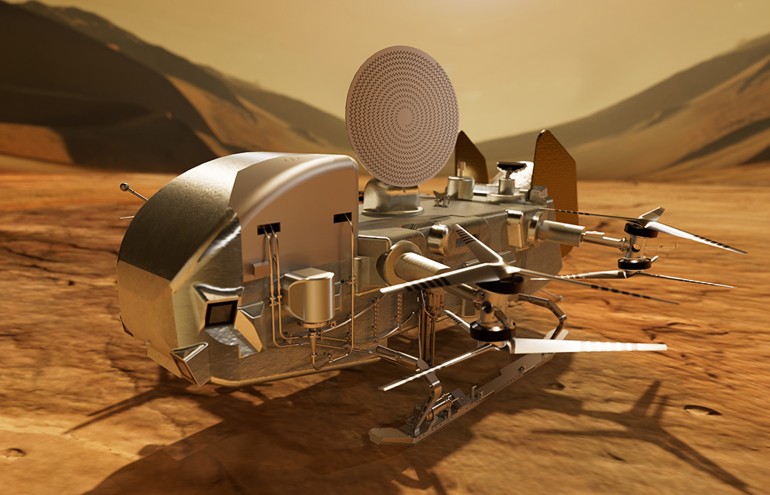
TT Electronics will supply its Hallogic Hall-effect sensors for NASA’s Dragonfly rotorcraft mission, to be integrated into fan assemblies. The sensors support a spacecraft subsystem where reliability and consistency are essential across the programme lifecycle.
Dragonfly is a rotorcraft lander mission to Saturn’s largest moon, Titan, that is designed to conduct science across multiple locations, sampling surface materials to measure their detailed compositions, and observing geology and meteorology. The Johns Hopkins Applied Physics Laboratory (APL) manages the Dragonfly mission for NASA and is building the rotorcraft, which is scheduled to launch in 2028 and reach Titan in 2034.
“Dragonfly is a mission that demands exceptional reliability and consistency, and we’re proud that the Hallogic OMH3075S has been selected for this application,” said Klaus Zwerschina, Interim VP Components, TT Electronics.
The Hallogic OMH3075S is a high-reliability Hall-effect sensor in the Optek portfolio, designed for non-contact switching and operation across a broad range of supply voltages. The device is specified for operation from -55°C to +150°C. For applications requiring enhanced screening, B and S versions are processed and screened to MIL-STD-883, with ESD Class 3B per the same standard.
“We work closely with customers to de-risk performance-critical designs, supporting programmes that value engineering continuity and a disciplined supply approach from design-in through production, for long service life,” added Zwerschina.
[Image credit: NASA/Johns Hopkins APL]