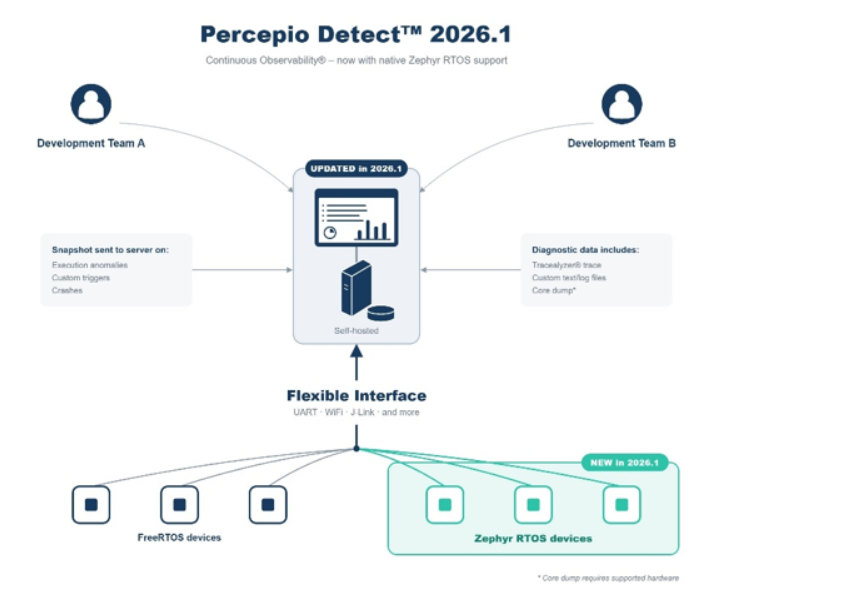
Percepio releases Percepio Detect 2026.1, adding comprehensive Zephyr RTOS support to its Continuous Observability platform. The release marks a significant milestone for the growing Zephyr ecosystem, enabling development teams to monitor, detect and diagnose system-level runtime issues directly on target hardware – without relying on full trace streaming or repeated fault reproduction.
“Zephyr support has been one of the most requested capabilities since we launched Percepio Detect, and we’re proud to deliver it as part of our 10th anniversary contribution to the community. With Detect 2026.1, embedded teams working on Zephyr can adopt continuous observability as a standard practice – bringing the same level of runtime visibility that FreeRTOS teams have already been using in production,” said Dr Johan Kraft, CTO and founder of Percepio.
Percepio Detect 2026.1 extends the platform’s “security-camera-style” monitoring approach to Zephyr-based systems. Rather than streaming all trace data continuously, Detect monitors the system and automatically captures compact diagnostic snapshots only when anomalies occur. These snapshots, including both traces and optional core dumps, can then be analyzed using Tracealyzer and Detect’s integrated core dump viewer to identify root causes quickly.
Core dumps and trace snapshots can also be triggered via a Detect API call on Arm Cortex-M devices, enabling teams to capture the active function call stack and surrounding runtime context even for non-fatal errors and warnings – without requiring a Zephyr fatal error.
By embedding observability directly into daily workflows, Percepio aims to shift industry practices from reactive debugging to proactive development. Instead of waiting for failures in late testing or in the field, teams can continuously verify system behavior and catch subtle issues early – before they escalate into costly defects.
Runtime observability is also becoming more relevant as agentic development gains traction in embedded software. With AI agents contributing more code, teams will need runtime monitoring during integration and system testing to detect undesired changes in performance, resource usage, and “near-miss” margins. This is feedback that agents typically lack, and an area Percepio aims to improve in the near future.
The combination of Percepio Detect and Tracealyzer provides a practical workflow from detection to root cause – even for intermittent issues that do not reproduce on demand. The solution is designed to run across a wide range of supported hardware platforms, with initial validation on popular development boards from Nordic Semiconductor and STMicroelectronics.
Percepio Detect 2026.1 is available now. A self-service evaluation download and a ready-to-run demo package with documented examples are available at percepio.com/detect.