IP-over-DWDM deployments based on 400ZR and OpenZR+ continue to expand. These are coherent optical networking standards used in transceivers to transmit high-speed data over fibre optic cables. 400ZR is a standard by the Optical Internetworking Forum (OIF), limited to short point-to-point data centre links, whereas OpenZR+ is an OpenZR+ multi-source agreement (MSA) standard that extends reach and flexibility for regional and long-haul networks.
In data centre interconnect (DCI) and metro networks, coherent optical modules are increasingly integrated directly into routers and switches, reducing the need for dedicated optical transponders. This approach lowers equipment costs, power consumption and rack space requirements.
At the same time, network operators increasingly build infrastructures that combine routers, optical modules, reconfigurable optical add-drop multiplexers (ROADMs), and optical transport equipment from different vendors. Greater flexibility in network design increases the importance of interoperability validation before deployment and communication quality assessment after service activation. Even when devices comply with the same standards, different vendor combinations can affect transmission reach and available performance margin. OpenZR+ adds further complexity by supporting multiple data rates from 100G to 400G, as well as multiple modulation schemes.
Consequently, network deployment requires more than connectivity verification. Engineers must evaluate whether a deployed network can maintain communication quality under operational conditions before service activation. This article discusses interoperability testing challenges in open optical networks, introduces key metrics used to evaluate communication quality, and describes testing approaches that improve the efficiency of quality assurance.
The accelerating adoption of open optical networks
Open optical networks are providing greater flexibility in network design by allowing operators to independently select routers, coherent optical modules, ROADMs and optical transport equipment. Network upgrades and capacity expansion can be introduced incrementally whilst reducing dependence on a single vendor. As a result, adoption of open optical architecture continues to grow.
At the same time, the validation burden has grown as the number of devices and possible combinations has expanded. Traditional single-vendor environments typically validate optical modules and transport equipment as an integrated solution. In open optical networks, however, routers, optical modules, and ROADMs often come from different vendors, creating many more combinations and test conditions that must be verified before deployment.
Widespread adoption of OpenZR+, with support for multiple data rates including 100G, 200G, 300G and 400G, further expands the scope of validation. Transmission conditions vary with network architecture and operational requirements and, even on the same platform, results can differ according to transmission distance and optical path configuration. Engineers must therefore assess a broader range of variables during interoperability and performance testing.
While open optical networks increase flexibility in equipment selection, they also increase the number of conditions that require verification before deployment.
Interoperability testing matters
Networks based on 400ZR and OpenZR+ do not always deliver the expected results, even when all devices comply with the same industry standards. For example, an optical module that operates normally in a laboratory environment may fail to establish a link when connected to an actual transmission path. In other cases, transmission reach may fall short of expectations, or forward error correction (FEC) counts may increase after service activation. Such issues occur more frequently in multi-vendor environments where routers, optical modules, ROADMs and optical transport equipment originate from different suppliers. Variations in implementation and configuration can affect receiver performance and communication margin, which engineers commonly evaluate using metrics such as pre-FEC bit error rate (BER), optical signal-to-noise ratio (OSNR) and FEC counts.
Fault isolation also presents a significant challenge. When communication quality degrades, engineers must determine whether the root cause resides in the optical module, transmission path or ROADM. Link establishment checks and throughput testing alone can’t identify the location of the degradation.
Another important consideration involves the difference between successful communication and a sufficient communication margin. An increase in optical fibre loss or a reduction in OSNR can raise the BER. As long as FEC continues correcting those errors successfully, the network remains operational and no service interruption becomes visible. A circuit may therefore appear healthy during commissioning whilst communication quality gradually deteriorates after deployment.
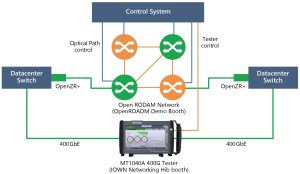
For this reason, interoperability testing evaluates more than successful link establishment, and industry organisations acknowledge this. The OIF continues to conduct interoperability testing at OFC Plugfest by combining 400ZR and OpenZR+ modules from multiple vendors; see setup example in Figure 1 (below). These tests evaluate not only link establishment but also OSNR and receiver performance, demonstrating that compliance with industry standards alone does not guarantee successful deployment.
Likewise, network operators require evaluation methods that help quantify quality variations and support deployment decisions as well as fault analysis.
The impact of equipment replacement and network changes
Measurements collected during interoperability testing, including pre-FEC BER, OSNR, FEC correction counts, and transmit and receive optical power, provide a baseline for assessing the impact of subsequent network changes; see Figure 2:
A single measurement result can’t determine whether a value originates from a configuration change or from the inherent characteristics of the network. Comparison between measurements collected before and after a change therefore becomes essential. For example, an increase in FEC counts following optical module replacement requires investigation to determine whether the change originates from the optical module itself or from transmission path conditions. Reviewing changes in pre-FEC BER and OSNR alongside FEC counts helps identify the affected section of the network and narrow down the relevant network component.
Such comparative analysis supports not only optical module replacement but also ROADM route changes, router upgrades and network expansion projects. Even when devices comply with the same standard, different combinations of routers, optical modules, ROADMs and transport equipment can produce variations in receiver performance and FEC levels. Validation therefore requires testing in the intended network configuration.
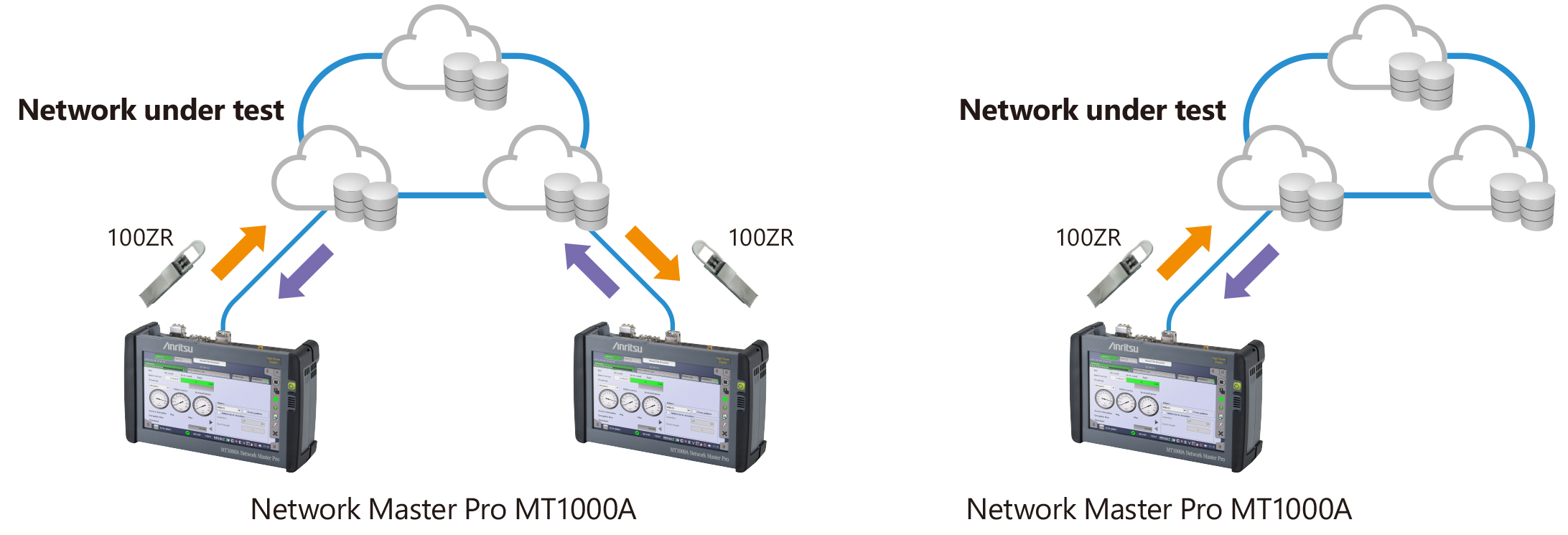
Anritsu Network Master Pro MT1040A performs Ethernet performance testing and coherent communication quality evaluation within a single test environment. In addition to throughput, frame loss and latency measurements, the platform acquires pre-FEC BER, OSNR and FEC counts. These capabilities support comparison of communication quality before and after a network change, as well as verification of communication establishment. As a result, deployment testing, post-upgrade validation and fault analysis can share a common evaluation methodology.
Comparative analysis becomes particularly important in multi-vendor environments, where optical module replacement, ROADM route modification and router upgrades can all influence communication quality. Measurements obtained under identical test conditions allow engineers to quantify the impact of each change.
Variations in pre-FEC BER, OSNR and FEC counts also support isolation of affected network sections and components when communication quality changes occur.
MT1040A supports 100ZR, 400ZR, OpenZR+ and OpenROADM environments, allowing the evaluation of a broad range of network architectures, including DCI, metro networks, and access or edge networks. Consistent test conditions across multiple data rates and transmission modes allow engineers to apply the same evaluation methodology from initial interoperability testing through to future expansion and upgrading projects.
Test scenarios further standardise wavelength configuration, service activation testing and communication quality evaluation. Re-testing frequently occurs during equipment replacement and fault investigation. Measurements collected under identical conditions improve comparison accuracy and simplify test record management.
Measurements collected before and after a network change provide a common basis for deployment decisions, equipment upgrades and fault analysis. Long-term accumulation of those results also establishes reference values for future network changes and troubleshooting activities. MT1040A provides an environment designed for that comparative evaluation process.
Of growing importance
400ZR and OpenZR+ have accelerated the transition toward open optical networks. Industry adoption of next-generation coherent technologies, including 800ZR, will further increase the complexity of interoperability testing and transmission quality assessment. Higher transmission rates increase capacity while reducing tolerance for design-margin limitations, implementation differences and transmission impairments.
While greater openness offers significant benefits, it does not simplify quality assurance. As a result, interoperability validation and communication margin assessment are increasingly important as networks incorporate equipment from multiple vendors.
The competitiveness of future networks will depend not only on transmission speed but also on the ability to quantify, monitor and manage communication quality. Robust quality assurance practices and repeatable evaluation methods will therefore be essential to the reliable deployment and operation of open optical networks.
By Tomohide Yamazaki, Assistant Manager, Anritsu