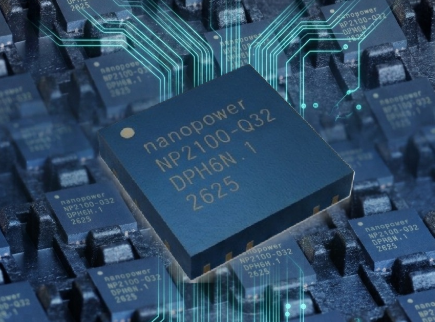
Nanopower Semiconductor, the fabless semiconductor company based in Kristiansand, Norway, has added nPZ2100 to its nPZero power-saving IC (PSIC) platform. Building on the nPZero architecture, the nPZ2100 enables battery-constrained sensor systems to operate with an ultra-low-power companion IC that can manage sensors and peripherals autonomously while keeping the host MCU powered down until it is genuinely needed.
“Battery life is a system problem. Even a processor with excellent sleep current can waste significant energy in sleep as well as being woken thousands of times a day to check for events that do not matter. With nPZero, our goal is simple: keep the processor off until there is something worth processing,” said Svein-Egil Nielsen, CEO of Nanopower Semiconductor.
With typical idle consumption of just 200nA at 3.0V and polling consumption of 1 µA, the nPZ2100 can autonomously manage up to six independent peripherals through I²C or SPI, with four integrated 1 mA peripheral power switches and a dedicated 10 mA host power switch. The device operates across an industrial temperature range of −40°C to +85°C.
As more processing and AI intelligence moves to the edge, managing power becomes just as important as delivering processing performance. High-performance MCUs, wireless SoCs and AI accelerators can consume significant energy, yet many applications only need this processing capability intermittently.
The nPZ2100 provides an ultra-low-power layer of system control around these power-hungry devices, monitoring sensors, analogue signals, timing and system events, and waking the host only when required. Its 256-byte SRAM, 8-bit three-channel ADC, 32-bit global time counter with alarm, watchdog and general-purpose event counter, together with power-aware operation for energy harvesting, give designers the tools to build systems around a simple principle: sense, decide, wake and process – rather than keeping the main processor running continuously.
The nPZ2100 can also power down peripherals when they are not required, helping eliminate their idle power consumption as well as reducing host MCU wake-ups. By taking over sensor communication and system monitoring while the host is powered off, the nPZ2100 can significantly reduce the host’s active time and overall system energy consumption.
With the EU Battery Regulation’s requirements for the removability and replaceability of portable batteries applying from 18 February 2027, the nPZ2100 can also help designers extend the operating life between battery changes, reducing the frequency of battery replacement while supporting more energy-efficient product designs.