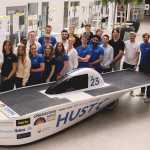
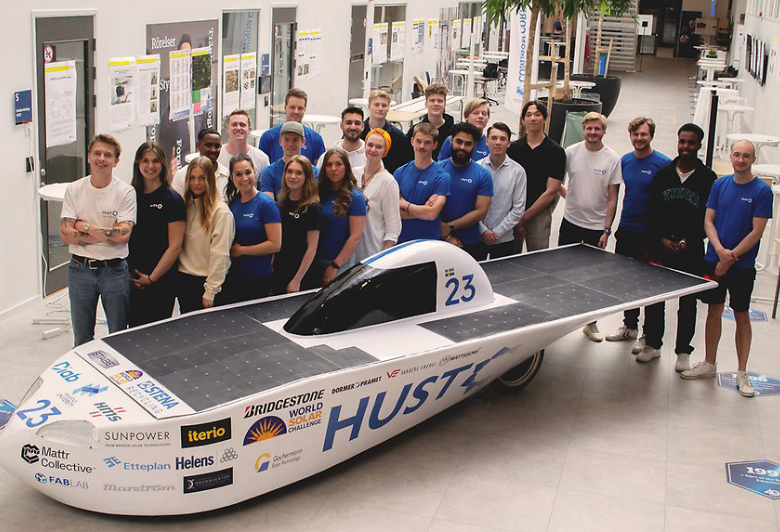
Across Australia in a solar racing car – aspiring engineers at Halmstad University in Sweden realise this dream every two years. In the World Solar Challenge, the vehicles have to endure a long distance, and a lot depends on battery quality. Prior to installation in the vehicle, the batteries must be carefully checked to detect even the slightest inconsistencies in the cells and optimize their performance.
The concrete challenges for the HUST team in what Wikipedia calls “the world’s toughest test of its kind”: Energy and installation space are in short supply, weight is detrimental to speed, any inefficient cell diminishes range, and even minuscule deviations have massive consequences. In the construction of the solar car, the students have used components from norelem. These include ceramic ball bearings and deep groove ball bearings, as well as extendable universal joint shafts. The components contribute to the functionality of the car’s mechanical design, where low friction, reliable rotation and efficient power transmission are key characteristics.
The same level of precision regarding the properties of battery cells is also important in industrial battery systems. Different capacities, internal resistances or charging behaviour can affect the performance and service life of the entire system. Precise sorting of cells is therefore crucial to the effort of minimizing differences and maximizing efficiency.
To meet these requirements, students at Halmstad University have developed an automated battery sorting machine as part of a bachelor’s thesis. It makes it possible to precisely measure, classify, and combine battery cells into homogeneous groups – a basic prerequisite for high-performance and long-lasting battery systems. The sorting machine loads cells via a magazine into a drum that rotates counterclockwise. At a measuring station, a HIOKI battery meter checks each cell: Unsuitable cells roll out directly, while accepted cells are stored temporarily for further use.
The machine is fitted with control devices and signalling units from norelem. These enable the machine’s functions to be controlled, its operation to be started and stopped, and an emergency stop to be initiated.
The projects demonstrate how engineering students can combine theoretical knowledge with practical problem-solving and technical components to develop innovative solutions. From mechanical designs in a solar-powered racing car to automated systems for battery quality – with the potential to make a difference far beyond the racetrack.