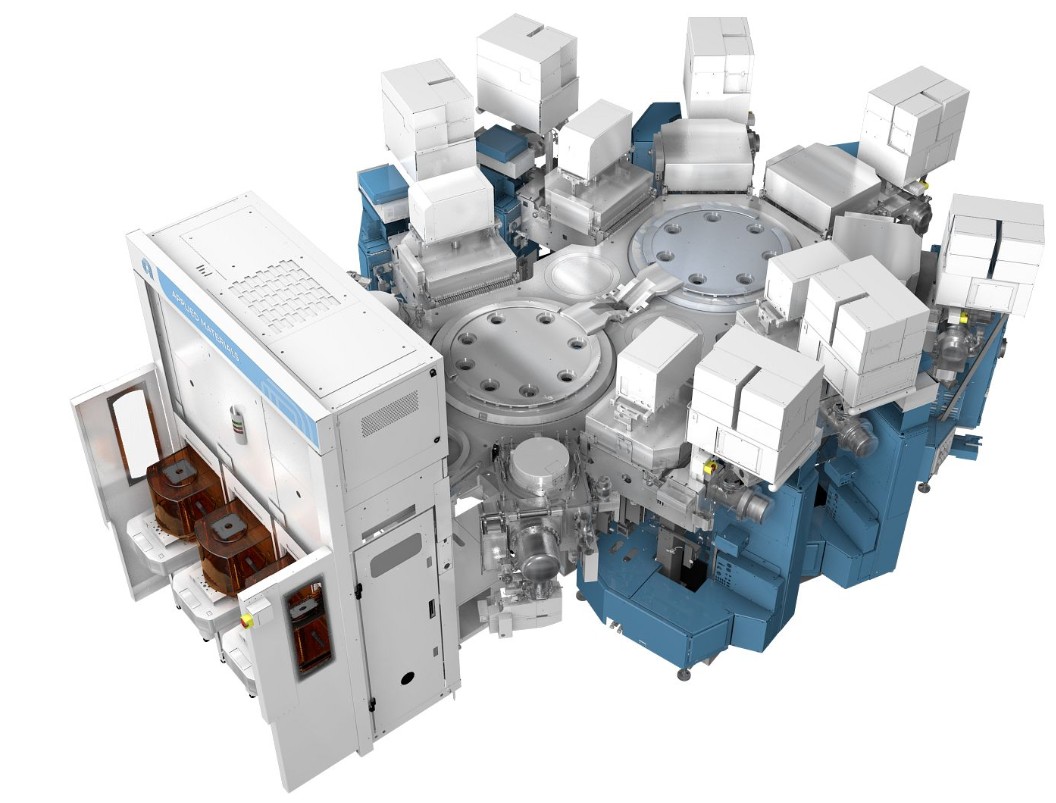
Engineering firm for the semiconductor industry, Applied Materials, introduced two chipmaking systems for creating the smallest features in the most advanced logic chips. By controlling materials deposition with atomic-level precision, the technologies enable chipmakers to build faster and more power-efficient transistors at the scale required to sustain the pace of today’s global AI infrastructure buildout.
Driven by surging demand for AI compute, the semiconductor industry is pushing the limits of scaling to squeeze more energy-efficient performance from each of the hundreds of billions of transistors in a processor chip. To address this challenge, the logic chipmakers are introducing new Gate-All-Around (GAA) transistors at 2nm and beyond. The GAA transition enables much higher performance at the same power, but achieving these gains comes with dramatically higher process complexity. Building the complicated 3D structures inside a GAA transistor takes more than 500 process steps, many of which require entirely new ways of depositing materials with precision, repeatability and control – all within tolerances approaching the size of individual atoms.
Next-generation AI GPUs now in development are expected to pack more than 300 billion transistors into a space the size of a postage stamp. Without proper isolation, electrons can easily diffuse into neighbouring transistors, leading to parasitic capacitance, an unintended electrical drag between transistors that slows signals, wastes power and negatively impacts a chip’s performance‑per‑watt.
“Our industry is entering a period of rapid, non‑linear change, where traditional lithographic chip scaling alone is no longer sufficient,” said Dr. Prabu Raja, President of the Semiconductor Products Group at Applied Materials. “At the most advanced angstrom-class logic nodes, performance and power are increasingly determined by materials. Thanks to our foundational leadership in materials engineering, these deposition systems will enable our customers to deliver critical transistor inflections that are foundational to the AI computing roadmap.”
The Applied Producer Precision Selective Nitride PECVD system uses an industry-first selective bottom-up deposition process to place silicon nitride only where it’s needed in the trench. It deposits a dense silicon nitride layer on top of the silicon oxide, which helps the isolation withstand later processing steps that would otherwise recess the STI material. The process operates at low temperatures to avoid any damage to the underlayer film or structure. By preserving the original shape and height of the isolation trench, Precision Selective Nitride helps maintain consistent electrical behaviour, reducing parasitic capacitance, lowering leakage, and boosting overall device performance.
The Applied Endura Trillium ALD system is an Integrated Materials Solution designed to precisely deposit metals in the most complex GAA transistor gate stacks. The system harnesses Applied’s legacy of leadership in metal ALD technology for advanced transistor applications. By integrating multiple metal deposition steps in a single platform, Trillium gives chipmakers the flexibility to tune threshold voltage across different transistors. Trillium leverages the proven Endura platform – the most successful metallization system in the history of the semiconductor industry – to create and maintain an extraordinarily high vacuum. This vacuum keeps wafers protected from impurities in the cleanroom atmosphere, which is critical when depositing multiple materials in the miniscule space between silicon nanosheets. By providing angstrom-level thickness control of metal gate stack layers, Trillium ALD delivers the tunability and reliability advanced GAA transistors demand, while improving transistor performance, power and reliability.