
Modern society is driven by electricity, powering everything from laptops to mobile phones, EVs, heating and cooling systems – absolutely everywhere. And now, the expansion of AI data centres worldwide requires even vaster amounts of electricity.
In 2023 some 60% of global electricity came from fossil fuels – a non-renewable resource. Fossil fuels cause huge environmental problems, producing enormous levels of C02, which in 2022 accounted for 70% of green-house gas emissions. Although oceans absorb some C02, the vast global deforestation reduces the Earth’s capacity to regulate the carbon cycle effectively, rapidly bringing us to an existential crisis. Electricity generation from fossil fuels has not only huge environmental and cost implications but creates noxious particulate matter causing illness and premature death – estimated at a loss of 3% of global GDP.
Year 2024 registered the highest total global consumption of electricity, reaching about 650 exajoules, with fossil fuel accounting for 80% of the mix. Demand for electricity rose by 4.3%, driven by AI data centre construction.
Coupled with health concerns and ever-growing costs, activists are now forcing governments to reduce dependence on fossil fuels, and some governments are already responding with energy policies focused on renewable sources.
Electricity consumption and generation
Major fossil fuel consumers are China, US, India and Russia, along with most of Europe – except for Scandinavian countries, Spain and France, where consumption is lower.
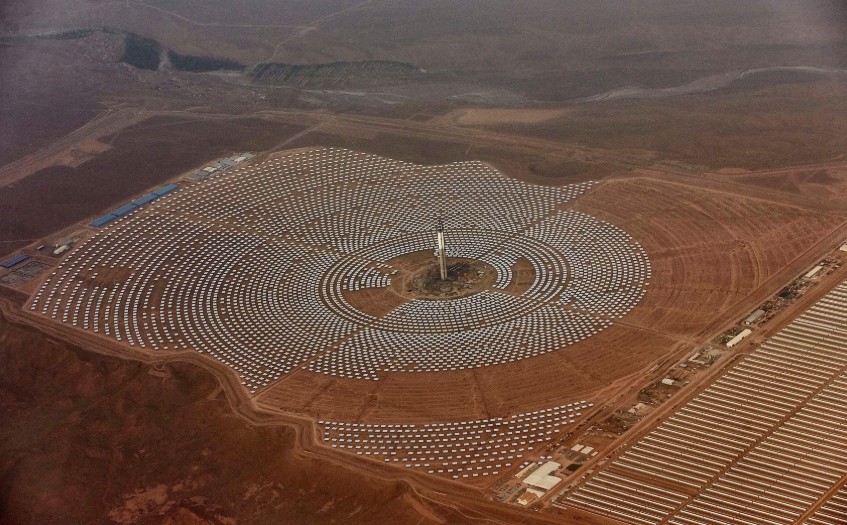
North African countries are high consumers of fossil fuel energy; however, Morocco has invested $9bn in a substantial solar complex – Noor Ouarzazate (see photo) – and with similar projects hopes to source 52% of its electricity needs from renewables by 2023. With its considerable solar potential, Morocco’s Concentrated Solar Power project aims to reach almost 3GW.
Morocco also plans to reduce its 90% energy dependency on imports, and seeks to export to Europe via 3,800km subsea cable, to supply 8% of the UK’s electricity by 2027.
If other North African countries apply the Moroccan model, such efforts could have great economic benefits for their countries long term, and in the process alleviate Europe’s reliance on fossil fuel energy from places like Russia and the Middle East.
Not all solutions need to be on a huge scale, however. A small but effective charity like Solar Aid works wonders. The charity aims to furnish homes, health clinics and local amenities with small sunshine-powered lights, starting from as little as £15. It’ll cost about £45 to light a classroom, maternity clinic or small market stall, and £60 buys a solar system to light a small family home.
Some of the solutions
In the UK, on the 15th March 2026, the Energy Secretary, Ed Miliband, committed measures to accelerate UK’s commitment to clean energy, including advancing the UK’s next renewable energy auction. The auction invites renewable energy companies to invest in the UK, with the aim to provide “clean power” to some 23 million homes. Furthermore, the UK government has achieved the largest offshore wind procurement programme in Europe, securing advances in meeting the UK’s clean energy targets.
The Energy Secretary also introduced plug-in low-cost solar panels that can be bought at supermarkets for domestic outdoor spaces. These will be available for the first time to UK consumers, yet are widely used in homes across Europe.
The UK government has also committed £15bn towards the Warm Home Plan to save energy – the largest public investment in British history to upgrade homes and facilitate insulation, helping reduce energy waste and bringing cost savings to consumers.
New legislation ensures new homes will integrate solar panels as standard, under the guidance of the Future Homes Standard.
Such measures in the UK, as well as across Europe, will reduce reliance on fossil fuel electricity, especially from Russia and Iran, where current geo-politics is increasing uncertainty in the global energy supply.
Industry and infrastructure
Industry still engulfs the largest portion of the energy pie with 30% usage. Transportation comes a close second, at 28%, and residential use is under 1/5 of all consumption (20%), according to 2022 data.
UK government figures in 2024 indicate usage of 128.1 million tonnes of oil equivalent (mtoe), with domestic use being 34.0mtoe and transport 54.0mtoe – 2.6 % higher than 2023 but 7.9% lower than 2019 (pre-Covid levels). Industrial consumption accounts for the remainder of the 128 million tonnes.
Currently in the UK, high energy consumption industries are given government subsidies through support schemes, such as the British Industry Competitiveness Scheme. The UK leads the world in offshore wind power with the largest ever investment in home-grown renewable power, to ensure both energy security and cost-effective supply. Offshore wind is 40% cheaper to build and operate than new gas power stations, placing the UK in a good position to secure its Net Zero targets. Five new windfarms entered production in 2022, delivering 3.7GW, mainly due to Hornsea Two. And in 2023, nine new projects add a further output of 3.3GW.
The Drax power station in Selby, North Yorkshire, produces 14TWh of electricity about 5% of the UK requirement of which some 10% is renewable.
Nuclear fission
In November 2025, the Office for Nuclear Regulation announced that the Wylfa site on Anglesey is believed to be confirmed as the new future location for Rolls-Royce small modular reactors (SMR).
The future – hydrogen and fusion
The current limitation for fusion remains the titanic amounts of energy required. Equally, hydrogen has its drawbacks, too, especially when it comes to its safe storage and transport.
Overall, the future can be better if we were to harness the natural resources like sun, wind and tides.
The ‘Boy Who Harnessed the Wind’ is a true story that came out of Africa and was made into a film, so in true likeness, let us harness existing resources to cost effectively provide us with clean energy.
By Karen Mascarenhas, Director, Mascarenhas PR
[Photo credit: AP Photo/Abdeljalil Bounhar, for Alamy]