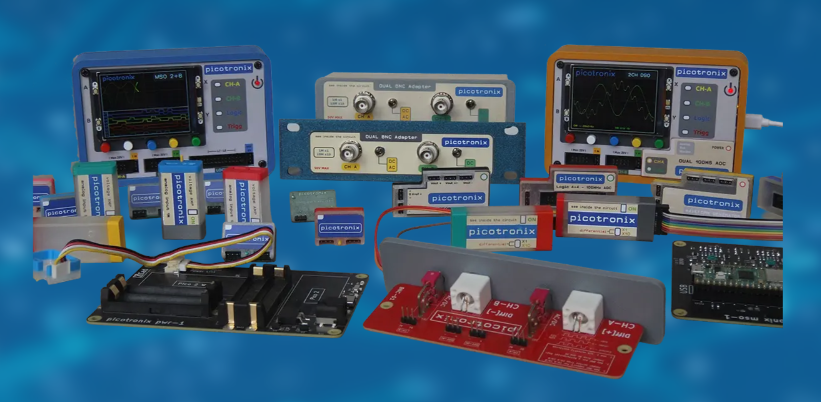
Sydney company Thort Werx has unveiled Picotronix, a modular test and measurement instrument with a structured AI interface engineered in from the start, so an AI can work inside the measurement loop: receiving each capture, analysing it and setting up the next measurement.
Picotronix is based on two Raspberry Pi Pico 2 units (a Pico 2 and a Pico 2W). Two Picos, one protocol Inside Picotronix, the work is split between two processors. The Pico 2 is the signal processor: it captures, and handles trigger level, offset, noise injection and negative bias.
The Pico 2 W runs the display and controls and recognises which picoPods are plugged in. The two talk through Picogram, a MessagePack
based datagram protocol developed for Picotronix, so each side can be developed and optimised independently. Both Picos are socketed, giving an upgrade path to future RP2350 parts.
The signal processor does not need to know what it is measuring. To it, every input is simply a 0-3V signal or a logic level. Whatever set up the capture knows what the signal means, such as which picoPod it came through and how it is scaled, and Picogram carries that information along the chain to whichever processor needs it.
Because the signal processor does not need to know who is on the other end, or what the signal means, an AI can use Picogram in exactly the same way. That puts the AI inside the measurement loop rather than outside it.
The Main Module is a two-channel digital storage oscilloscope, an 8-channel logic analyser (up to 14 channels with a picoPod) and a frequency meter, with three expansion ports and a 320 × 240 colour LCD. On its own it uses the RP2350’s native 12-bit ADC.
The ADC-100 picoPod adds two 100 MSPS 8-bit converters, one per channel and clocked together so captures stay coherent. Driven by the RP2350’s PIO state machines with DMA into up to 64K of buffer, it captures up to 75MSPS on one channel or 50MSPS on both, down to 10 ns/div. The limit is the RP2350, not the ADCs: at its rated 150MHz, with two clocks per sample, sampling peaks at 75MSPS.
Other picoPods add precision analog windows, a differential pod with ±25 V common-mode range, a 12-bit waveform generator, and 12-channel logic capture at 150 MSPS across 1.8, 2.5, 3.3 and 5V logic families.
Picotronix is programmable in MicroPython, with direct access to the RP2350’s PIO state machines and 12 buffered, protected I/O lines. Everything is open, so users can write their own virtual instruments or design their own picoPods.
“We wanted to see inside the circuit without paying for a bench full of instruments,” said John Griffits, co-founder of Thort Werx. “The RP2350’s state machines are far too good to hide in a black box, so everything is open. If you need a pod we haven’t made, design one.”