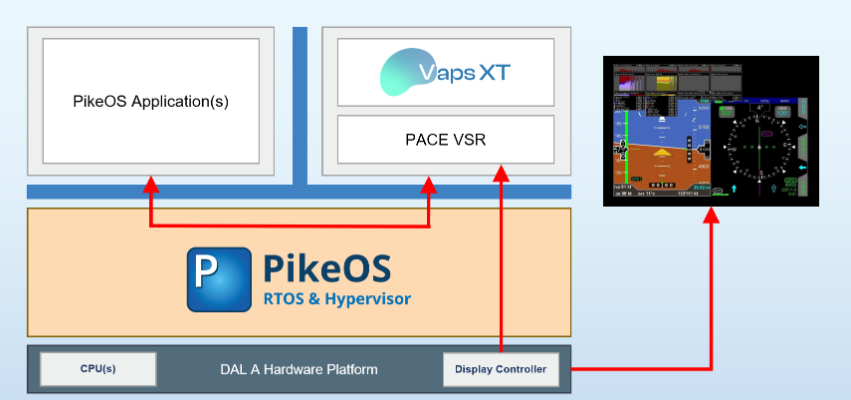
European software specialists, SYSGO and PACE, combine certifiable real-time operating system technology with advanced software-rendered cockpit graphics to simplify and de-risk avionics development and certification.
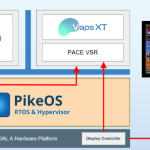
With SYSGO’s certifiable PikeOS real-time operating system (RTOS) and hypervisor with PACE’s VAPS XT development environment and VAPS Software Renderer (VSR), the partners aim to simplify the development, integration and certification of safety-critical cockpit graphics while reducing reliance on dedicated graphics processing units (GPUs). The first port of VSR to PikeOS has already been completed.
Modern avionics systems must process and visualise increasingly complex information while meeting stringent requirements for deterministic execution, functional safety, and long-term reliability. Traditional GPU-based graphics architectures can introduce additional hardware dependencies, software complexity, and certification challenges. By combining a mature real-time operating system with a software-based graphics rendering solution, SYSGO and PACE offer aerospace manufacturers and system integrators a flexible alternative designed specifically for the demanding requirements of high-DAL airborne applications.
At the foundation of the joint solution is PikeOS, SYSGO’s field-proven real-time operating system and hypervisor, developed for safety- and security-critical embedded systems. With more than two decades of deployment experience, PikeOS provides a deterministic execution environment, controlled resource management, and a mature software architecture designed to support the highest levels of safety assurance, including DO-178C Design Assurance Level A (DAL A).
PikeOS provides the underlying operating system services needed to execute time-critical avionics applications predictably and reliably. Its real-time scheduling capabilities, memory protection, and controlled execution environment offer a robust foundation for PACE’s software-based rendering technology. In particular, its certification-oriented development approach and available certification evidence help manufacturers integrate the graphics subsystem into their overall avionics certification activities.
PACE contributes its advanced VAPS XT HMI development environment and VAPS Software Renderer (VSR), enabling developers to design and deploy sophisticated cockpit displays without requiring dedicated GPU hardware. Instead of depending on complex hardware-accelerated graphics drivers, VSR performs graphics rendering in software on the CPU. The approach provides predictable graphics processing, increases hardware flexibility, and can reduce the complexity associated with certifying safety-critical display applications.
Together, these technologies establish a software architecture in which graphics design, rendering, and real-time execution are supported by complementary technologies engineered with avionics certification requirements at their core.