
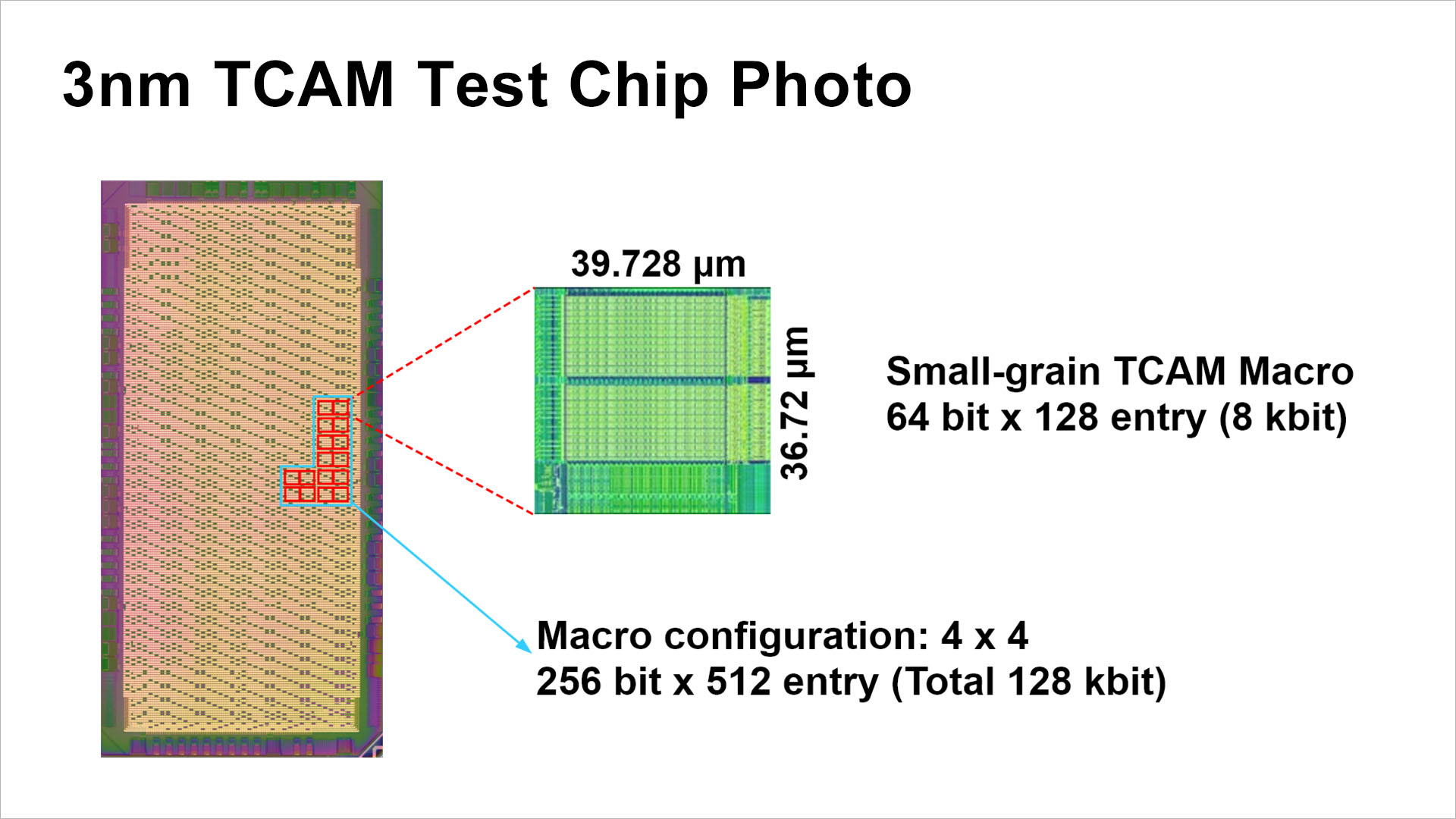
Renesas Electronic produces a configurable ternary content-addressable memory (TCAM) built on a 3nm FinFET process. Its higher density, lower power and strengthened functional safety make it suitable for automotive applications.
The TCAM hard macros are supported by a memory compiler in search key widths of 8-64 bits and entry depths of 32-128. Larger configurations (e.g., 256-bit × 4,096 entries) are realised by combining them with tool-driven soft-macro auto-generation to offer on a single chip a configurable single macro. This achieves industry-leading memory density of 5.27Mb/mm².
Each hard macro integrates an all-mismatch detection circuit, which determines in the first search stage whether all entries are mismatches and controls whether the second stage is executed, thus avoiding unnecessary energy consumption. For example, in 64–256-bit × 512-entry configurations, the approach reduces search energy by:
- Up to 71.1% with column-wise pipelined search (with key partitioning, >64-bit keys)
- Up to 65.3% with row-wise pipelined search (without key partitioning, ≤64-bit keys)
Because TCAM bitcells for the same address are physically adjacent, a double-bit error caused by soft errors cannot be corrected by conventional SECDED ECC (Note 2). Renesas mitigates this with two techniques: The first is a split odd/even data buses for user data and ECC parity to increase physical separation between memory cells, converting potential double-bit errors into correctable single-bit errors. The second consists of a dedicated SRAM for ECC parity with an address decoder independent of the TCAM, improving detectability when an incorrect address is selected during TCAM writes.
These measures significantly improve safety coverage required in automotive contexts. The TCAM’s flexible key widths and entry depths, combined with power savings and robust functional safety, make it well-suited not only for automotive use but also for industrial and consumer devices where high-speed data exchange between sensors and processors is essential. Renesas will continue to advance memory architectures that deliver high capacity, low power and high reliability.