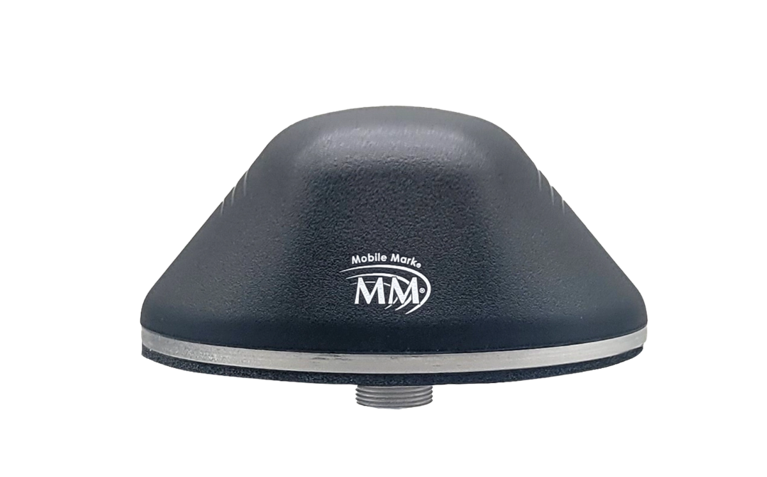
Mobile Mark recently introduced two new antenna platforms, the LTM900 Series and BSLLG3-600/7200, extending its range of wireless solutions for vehicle, infrastructure and fixed-site applications. Astute Group, an authorised distribution partner for Mobile Mark across Europe and beyond, provides access to the manufacturer’s antenna portfolio alongside technical and design-in support.
Mobile Mark state that the new products combine updated mechanical designs with wireless performance aimed at current connectivity requirements. The LTM900 Series is a configurable multiband surface-mount mobile antenna platform, while the BSLLG3-600/7200 is a MIMO omnidirectional antenna for multi-network LTE and 5G deployments.
LTM900 Series targets compact multiband vehicle installations
The LTM900 Series provides a single antenna platform capable of supporting multiple wireless functions. Mobile Mark states that configurations can accommodate four 5G Sub-6 cellular elements, up to six Wi-Fi 6E/7 elements and one GNSS element.
An alternative configuration supports up to five Wi-Fi 6E/7 elements alongside one GNSS element. This allows antenna configuration to be matched to the wireless requirements of the vehicle or mobile platform rather than relying on separate antenna assemblies for each function.
Mobile Mark has also redesigned the radome, with the company stating that the updated aerodynamic design provides improved environmental shielding against rain and ice. The platform is also the company’s first radome available in custom colours.
Robert Johnson, President and CEO of Mobile Mark, said: “The LTM Series set a standard in wireless communications and remains a leading antenna in the fleet, and mobile markets today.”
The custom-colour option is intended for applications where the antenna needs to match platform colours, including public safety, military and covert vehicles. For vehicle manufacturers and system integrators, the configurable platform provides a route to combine cellular, Wi-Fi and GNSS connectivity within one surface-mounted antenna assembly.
BSLLG3-600/7200 adds wideband cellular MIMO
The BSLLG3-600/7200 addresses a different installation requirement, providing an omnidirectional MIMO antenna for wideband cellular networks. Mobile Mark states that the antenna supports LTE and 5G deployments across wideband cellular frequencies.
The design integrates 2x cellular MIMO and is intended to improve network throughput and reliability. This makes the antenna relevant to fixed infrastructure and other installations where multi-network cellular connectivity is required.
Mobile Mark describes the product as supporting positioning as well as integrated 2x cellular MIMO, providing multiple functions within a single antenna platform.
Stay ahead on electronics news
Join the electronics industry Astute Engineer newsletter
Mobile Mark antenna supply through Astute Group
Astute Group’s Mobile Mark portfolio covers vehicle-mounted, infrastructure and fixed-site antennas, as well as embedded and active antenna systems. The range supports cellular, Wi-Fi and GNSS requirements, with Mobile Mark products covering frequencies from 150 MHz to 7.2 GHz. Astute also lists Cellular IoT and M2M antennas covering 600-6000 MHz.
The addition of the LTM900 Series and BSLLG3-600/7200 gives that portfolio two further options covering multiband mobile installations and wideband cellular MIMO infrastructure. For new equipment programmes, the combination of standard antenna platforms, configurable options and custom engineering can reduce the need to develop an antenna assembly from the ground up.
Mobile Mark’s products are designed and manufactured across its US and UK facilities, while Astute provides authorised distribution access to the range across Europe and beyond. This gives customers a direct route to Mobile Mark’s standard and configurable antenna products while retaining access to design and engineering support where application requirements extend beyond a standard configuration.
Damian Semple, Franchise Marketing Manager, comments: “The two platforms give customers more choice at the antenna selection stage, particularly where multiple wireless functions need to be accommodated in one assembly. Having standard products available alongside configurable and custom options also gives sourcing teams more flexibility when application requirements change during development.”