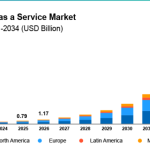

The central question in humanoid robotics is no longer whether the machines can walk. It is who carries the risk when they stumble. For leaders weighing a first deployment, that question changes the whole decision. Humanoid Robot as a Service (RaaS) shifts capital, maintenance and obsolescence risk to the provider, so customers pay for access or results instead of a depreciating asset. Polaris Market Research sizes the segment at $0.79 billion in 2025 and projects $27.63 billion by 2034, a 42.11% compound annual growth rate. The headline matters less than what it signals: buyers are choosing to rent productivity.
Humanoid autonomy is improving quickly but is not yet flawless, and that gap defines the commercial logic. A robot that completes a task 95% of the time still fails once in twenty attempts, which is unworkable on a continuous production line. Under ownership, the buyer absorbs those failures. Under RaaS, the provider pays for interventions, spares and software tuning until performance stabilizes.
That is why monthly subscription and lease contracts held 41.72% of the market in 2025. The structure gives finance teams a predictable monthly cost and gives operators a way to test robots in real workflows before committing. Adoption follows a visible ladder. Onsite pilots made up 38.46% of 2025 activity, and scaled fleet deployments are forecast to grow fastest, at 53.27% annually. Toyota’s Canadian plant converting a pilot into a commercial agreement with Agility Robotics shows the path from experiment to recurring contract.
The strongest signal is where contracts are heading. Pay-per-hour and pay-per-task models are projected to grow at 44.38% annually, and outcome-based labor contracts at 51.38%. Customers increasingly want completed totes, parts loaded or inspections finished, not equipment.
This works first where performance is easy to measure. Material movement led task adoption with 29.74% of 2025 revenue, and logistics and warehousing led industries at 25.84%. Agility’s Digit has moved more than 100,000 totes at a live GXO facility, and Figure reported over 1,250 runtime hours and 90,000 parts loaded in a BMW program.
The risk transfers too. Output pricing makes robot labor directly comparable with outsourced labor, but providers must then guarantee uptime and low intervention rates. Buyers should negotiate on productive hours, mean time to repair and replacement commitments, not on autonomy claims in a sales deck. Motion’s 48-hour replacement pledge is the kind of term worth benchmarking against.
North America led in 2025 with a 39.28% share, helped by early commercial deployments and heavy physical AI investment. Asia Pacific is the growth story, forecast at 49.36% annually, backed by manufacturing depth. UBTech’s new Guangxi factory, designed for more than 10,000 robots a year, shows how fast supply is scaling.
Europe is projected to grow 40.81% annually as automakers explore humanoids for material handling, and Minth Group’s planned Serbian production with AGIBOT adds regional capacity. The Middle East and Africa (44.16%) are attracting rental-style offers, such as AGIBOT’s daily rentals starting at $533. Latin America held 4.71% of the market in 2025, where local service infrastructure will determine the pace.
Two playing fields are emerging. OEM-led providers such as Agility, Figure, UBTech and Apptronik bundle their own hardware with services. Hardware-agnostic platforms such as Motion combine leasing, insurance, maintenance and fleet software across multiple robot brands, owning the customer relationship rather than the machine. Newer entrants including 1X, Robot.com, RaaSX and RobotLAB are testing consumer subscriptions, quick deployment and fixed-term contracts.
The durable advantage may be data. Every deployment produces task demonstrations and failure cases that improve future performance, so larger fleets can compound their lead. Software also persists as hardware prices fall: fleet management, teleoperation and maintenance generate recurring revenue regardless of what the robot costs.
Several shifts look likely. Contracts will standardize around uptime and task-success metrics, making providers easier to compare and giving lenders clearer visibility into fleet cash flows. Wheeled and upper-body designs, growing at 37.84% annually in the wheeled case, will take structured-floor tasks where walking is unnecessary. Automotive manufacturing, forecast to grow 46.36% annually, will be a proving ground. Consumer subscriptions, such as 1X’s $499-per-month NEO, could broaden demand later.
Humanoid RaaS succeeds because it aligns incentives. Providers profit only when robots work, and buyers pay only for what they use. For operators, the practical path is to start with a measurable, repetitive task, insist on output-linked service terms, and choose partners for reliability and local support. As autonomy matures, the market will reward whoever delivers dependable productive hours. Leaders who learn to buy robotic labor on those terms now will be better placed when the category scales.