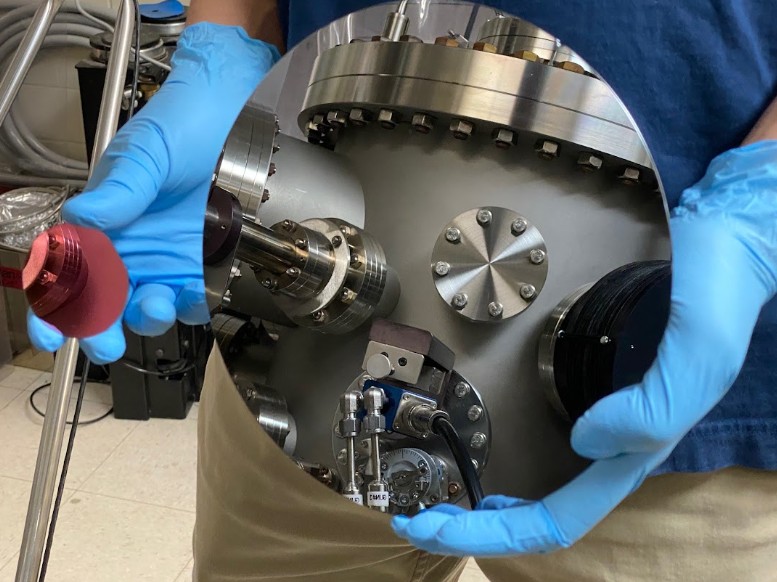
The manufacturer of high-performance materials for silicon photonics, La Luce Cristallina, has made its beta version of a 200mm (8-inch) barium titanate (BaTiO₃) available to customers for evaluation. R&D teams working with advanced electro-optic modulators for telecommunications and data communications applications will benefit from the ultra-low-voltage operation BaTiO₃ platform that addresses the bandwidth and power demands of AI-scale data centre infrastructure, and even supercomputers.
“The beta version of our barium titanate wafer marks another step toward advancing co-packaged optics amid the rise of AI, quantum photonics and other high-capacity applications. With it, current and prospective customers can unlock the full potential of barium titanate for powering multiple generations of electro-optic innovation across diverse use cases,” said Agham Posadas, CTO and Co-Founder, La Luce Cristallina. “
The BaTiO₃ platform can be cleanly integrated end-to-end into standard CMOS silicon manufacturing processes, facilitating rapid adoption without fab retooling. BaTiO₃ provides extremely high Pockels coefficient, which defines the strength of the linear electro-optic effect, a phenomenon where a material’s refractive index changes proportionally to an applied electric field. In case of La Luce Cristallina’s BaTiO₃ bulk single crystal that coefficient reaches about 1,300pm/V in, enabling ultra-low-voltage electro-optic modulators across numerous photonics applications. These benefits are placing this platform in a leading position of electro-optic materials for low-loss, high-speed switching in quantum optical circuits.
With advancements made in AI and machine learning, quantum computing market is gaining further strength, supported with significant investment. This market is projected to reach $20.5bn by 2035 at a compound annual growth rate of nearly 26%. The biosensing market is also seeing substantial growth, driven by growing demand for continuous health monitoring. This market is expected to reach $67bn by 2034, from the current year’s $33bn. Both are seen as benefiting from the BaTiO₃ platform.