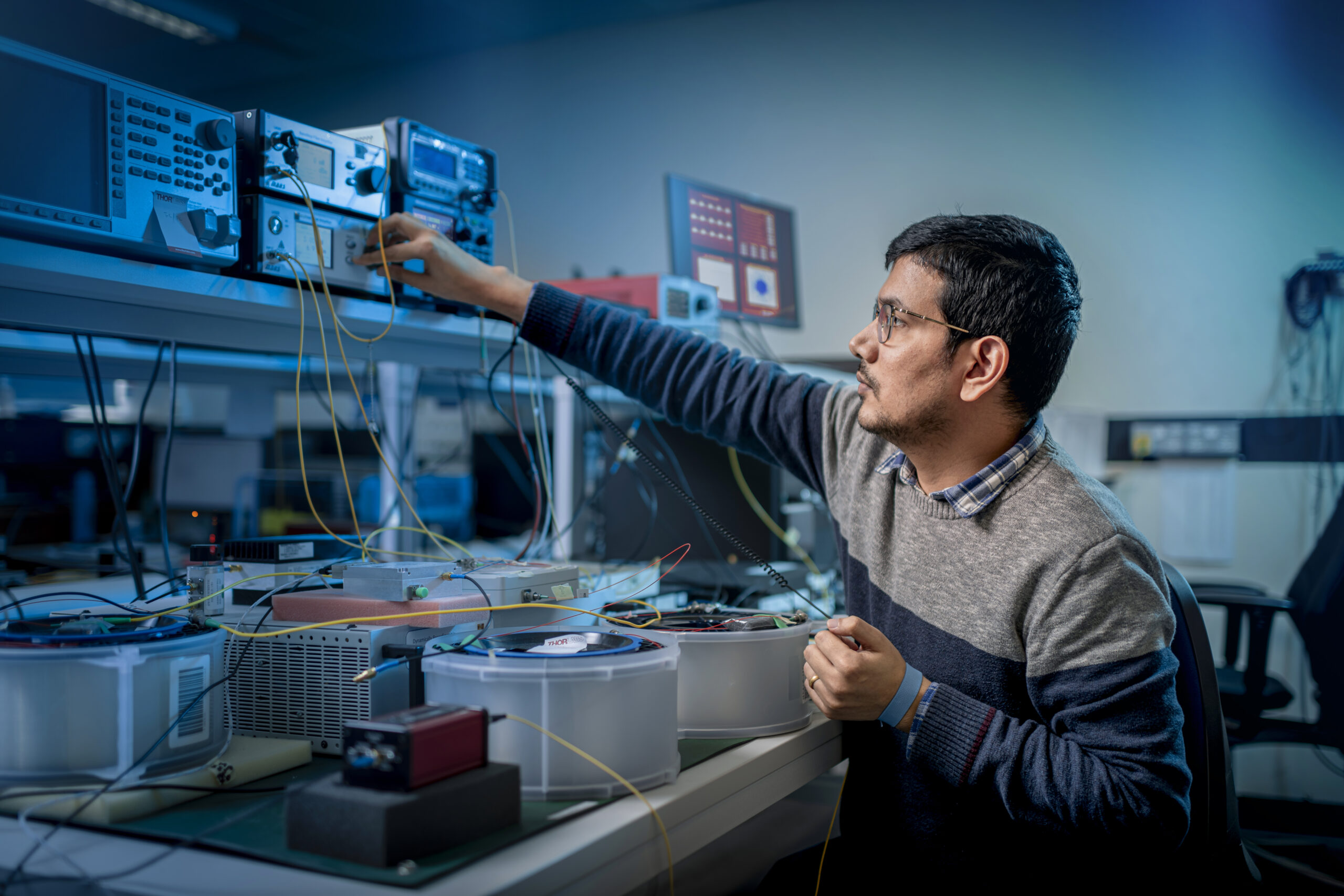
Researchers at Bangor University’s Digital Signal Processing (DSP) Centre have found a cost-effective way to improve the performance of networks which supply mobile services and broadband, but in a much kinder way to the planet. Because of the technique’s simplicity, it requires less energy to transmit data, reducing the environmental impact.
The process involves using DSPs to transform complicated, non-linear, low-speed optical transmission systems into simple, linear, high-speed ones, achieving a ten-fold increase in bandwidth of commercially-installed access networks. Demos proved the technique’s feasibility over 100km distances.
“Using advanced digital signal processing, we are manipulating the way in which signals are processed in the receiver to compensate for the effects that usually limit bandwidth and transmission distance. This approach could be used to upgrade existing networks without requiring considerable changes to be made to these networks,” said Professor Jianming Tang, Director of the DSP Centre at Bangor University, North Wales. “We are now looking at how this approach could be further integrated with the DSP Centre’s other cutting-edge techniques to provide additional network security by detecting unauthorised changes to the network and unauthorised access to the data, which is of paramount importance these days. The approach also allows cheap and low-power consumption solutions to be deployed in new networks, capable of satisfying unprecedented technical requirements associated with 5G and beyond.”
The DSP Centre at Bangor University has secured £3.9m from the European Regional Development Fund through the Welsh government, and a further £3m from the North Wales Growth Deal, to invest in expansion and new equipment, and create up to 40 new jobs.