Artificial intelligence has evolved from rule-based systems to deep learning and large language models (LLMs). Today’s generative AI can draft prose, translate languages, and generate media in response to prompts. But these models remain, at their core, reactive: they respond to a cue and produce a single output. The next phase of AI focuses on building systems that can reason, plan, and act autonomously over time — an approach known as agentic AI.
For engineering teams deploying intelligent behaviour in embedded and edge systems, agentic AI brings real potential alongside significant practical challenges. Making these systems work in production depends on architectural choices, explicit trade-offs, and an understanding of how autonomous behaviour interacts with compute, timing, and safety constraints. This article treats agentic AI as an engineering discipline, shaped by deployment constraints, system design decisions, and real-world trade-offs.
While Large Language Models (LLMs) have popularized agentic concepts, deploying them at the edge requires a shift in scale. Moving from the cloud to an MCU or MPU necessitates the use of Small Language Models (SLMs) and aggressive quantization techniques. These optimizations compress reasoning capabilities into footprints that fit within limited SRAM and Flash, making ‘intelligence’ a local resource rather than a remote service.
From Reactive to Autonomous: What Makes Agentic AI Different
Traditional AI systems, including most deployed deep learning models, are stateless responders. Given a prompt or input, they produce an output without internal persistence or long-term objectives. An LLM might summarize a document or answer a question but does not incrementally pursue a goal or alter its strategy over multiple steps. This works well for discrete tasks but falls short when systems must operate continuously and interpret feedback without explicit instructions.
Agentic AI, on the other hand, is designed to operate autonomously toward higher level goals. Rather than waiting for prompts, an agentic system can assess its environment and objectives before acting, plan sequences of actions that move it toward a goal while revising those plans as new information arrives, and act continuously, not just producing a single output but engaging with a task over time.
This change has direct implications for embedded and edge systems. In robotics, autonomous vehicles, industrial automation, and intelligent IoT devices, systems must interpret sensor streams, integrate multi-modal data, and make timely decisions under resource constraints. Agentic AI approaches offer the promise of adaptive, context-aware autonomy, but to realize that promise in practice, engineers must account for new design and deployment trade-offs.
Core Elements of Agentic AI Systems
Agentic AI systems differ from reactive models not because they employ a specific algorithm, but because of how decision-making is organised over time. Rather than responding to isolated prompts, agentic systems maintain internal state, pursue objectives, and adapt their behaviour as conditions change. This results in a distinct system architecture built around persistence, feedback, and autonomy.
A defining feature of agentic systems is goal-driven behaviour. Instead of executing predefined responses, these systems operate against explicit objectives that shape how decisions are prioritised. Goals may be hierarchical, with high-level objectives decomposed into intermediate steps and constrained by operational limits such as safety, latency, or power consumption. In embedded and edge systems, this structure provides a way of balancing competing requirements while maintaining predictable behaviour.
For example, where a reactive system might trigger a hard emergency stop upon detecting any vibration anomaly, an agentic sensor can perform a cost-benefit reasoning task: it evaluates the severity of the fault against the current production state, deciding to complete the current high-value batch at a reduced speed before initiating a controlled shutdown, thus preventing both equipment damage and unnecessary material waste.
Equally important is continuous planning and adaptation. Agentic systems plan sequences of actions rather than single responses, revising those plans as new information becomes available. Feedback from sensors, system state, or environmental changes informs subsequent decisions, allowing the system to respond to uncertainty and variation. This capability is essential in dynamic or partially observable environments where static control logic quickly becomes inadequate.
Agentic AI also depends on contextual awareness, often derived from multiple data sources. Embedded and edge systems typically rely on heterogeneous sensors, each offering a limited perspective. Agentic architectures integrate these inputs into a coherent internal representation that informs decisions over time. Context allows similar situations to be handled differently depending on operational history, current conditions, or evolving objectives.
These characteristics define how agentic AI is implemented within a system. Rather than operating as an isolated inference engine, the AI is integrated as a decision-making component that maintains state, evaluates objectives, and issues actions over time. In embedded and edge deployments, this places agentic AI alongside other core subsystems, subject to the same constraints around timing, resource usage, and safety.
Deployment Constraints at the Edge
In embedded and edge deployments, agentic AI operates as a decision-making component within a larger system. It maintains state, evaluates objectives, and issues actions over time. Like other subsystems, it is subject to constraints around timing, resource usage, and safety, which shape how much autonomy is practically feasible.
One of the most significant constraints is compute and power availability. Agentic AI systems often require sustained processing for reasoning and planning, which can be difficult to support on energy-constrained platforms. Engineers must decide how much autonomy can be supported locally, what level of optimisation is required, and whether workloads should be distributed across heterogeneous processors or offloaded selectively.
Latency and determinism introduce further challenges. In many embedded applications, decision-making must occur within bounded time windows. Planning and reasoning loops that vary in execution time can undermine predictability if not carefully managed. Agentic systems therefore need to be designed so that autonomous behaviour coexists with real-time control requirements, often through architectural separation between high-level reasoning and low-latency execution paths.
Safety and reliability impose additional constraints. As systems gain autonomy, they must also demonstrate predictable behaviour under fault conditions. Embedded agentic systems require clear boundaries on what autonomy is permitted, how failures are detected, and how systems transition into safe states. These considerations tie agentic AI closely to established safety engineering practices rather than treating it as an isolated software concern.
Architectural Considerations for Agentic Systems
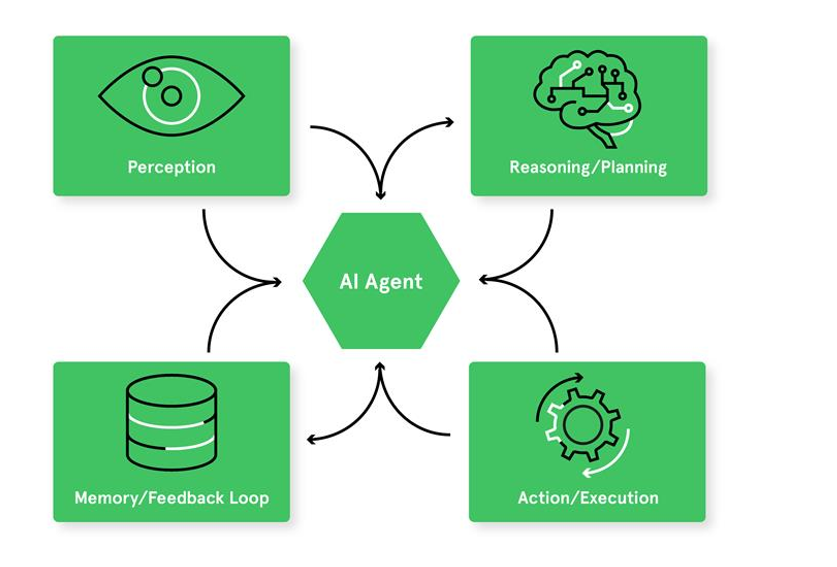
Turning agentic concepts into deployable systems requires explicit architectural choices. Successful implementations typically separate perception, reasoning, planning, and execution into modular components, allowing complexity to be managed and constrained where necessary.
Perception modules ingest and preprocess sensor data, while state representations aggregate this information into a form suitable for reasoning. Planning components generate action sequences aligned with system objectives, and execution layers translate plans into concrete actions while enforcing timing and safety constraints. This modularity allows agentic behaviour to be introduced incrementally and tested independently.
Many systems also employ hierarchical control structures, where high-level goals guide mid-level planning, and low-level controllers enforce deterministic behaviour. This hierarchy makes it possible to introduce autonomy without compromising stability or responsiveness, particularly in systems where control loops must meet strict timing requirements.
Feedback loops play a central role. Agentic systems rely on continuous feedback to assess outcomes and adjust behaviour. In embedded deployments, feedback mechanisms must operate reliably despite intermittent connectivity, noisy sensors, or partial observability. Designing these loops is as much a systems engineering task as an AI one.
Where Agentic AI Delivers Value
When treated as an engineering discipline rather than an abstract capability, agentic AI addresses limitations that reactive systems struggle to overcome. In embedded and edge environments, its value lies in enabling systems to adapt over time, manage uncertainty, and pursue objectives without constant external input.
Autonomous machines, intelligent infrastructure, and adaptive control systems are promising candidates for agentic AI deployment. In each case, agentic AI supports behaviour that evolves in response to changing conditions rather than relying on static decision rules. This adaptability is particularly valuable where environments are unpredictable or where manual intervention is impractical.
Fr0m Concept to Deployment
Deploying agentic AI is typically incremental. Teams begin by enhancing perception and contextual awareness before extending decision logic and planning under clearly defined safety boundaries. Introducing autonomy in stages allows behaviour to be validated and refined without destabilising the wider system.
As systems take on more autonomous decision-making, continuous measurement becomes essential. Engineers must track how agentic behaviour affects latency, resource usage, and system stability, using operational data to adjust trade-offs and maintain predictable performance over time. Without this feedback, staged deployment can outpace system capability.
Translating architectural intent into a working system then requires alignment between software design and hardware capability. Decisions about reasoning depth, memory allocation, timing behaviour, and power consumption must reflect the realities of the target platform, particularly in embedded and edge environments where constraints are fixed.
Throughout this process, a strong ecosystem can reduce implementation risk and technical uncertainty. As a leading semiconductor distributor, Avnet Silica works with engineering teams to evaluate platform trade-offs, align workloads with appropriate hardware, and address lifecycle and availability considerations. This hardware-aware design guidance helps developers move from concept to deployable systems with greater confidence in long-term stability and scalability.
Conclusion: Engineering Autonomy for the Real World
Agentic AI represents a shift from isolated inference toward systems that reason, plan, and act over time. For embedded and edge deployments, this change is significant not because of new algorithms, but because of how autonomy must be realised within real-world constraints.
By treating agentic AI as an engineering challenge defined by system architecture, resource limits, and safety requirements, teams can move beyond abstract discussion and focus on deployable solutions. The principles outlined here point toward a disciplined approach to autonomy—one that balances ambition with practicality and aligns intelligent behaviour with the realities of embedded and edge systems.
[Figure 1: Continuous planning and feedback loops enable agentic systems to operate reliably within the fixed constraints of embedded and edge platforms. Source: adapted from Sudarshan Poudel, ‘How AI Agents Think, Plan and Act — Let’s Build One with LangChain’, Medium.]
By Michaël Uyttersprot, Market Segment Manager for Artificial Intelligence, Machine Learning, and Vision at Avnet Silica