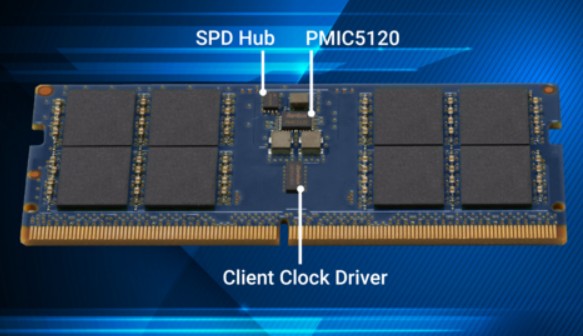
Rambus announced its complete Client Chipset memory for CUDIMM and CSODIMM modules aimed at next-generation AI PCs. It includes the new Gen2 Client Clock Driver (CKD02), delivering breakthrough performance with support for PC memory module operation of up to 9600MT/s, power management IC (PMIC5120) and serial presence detect hub (SPD Hub).
With the rise of agentic AI, PCs now plan, execute, and adapt workflows in real time. These workloads require persistent context, concurrent processing, and continuous data movement between the processor and system memory requiring significant increases in both bandwidth and capacity. At the same time, scaling DDR5 memory beyond 6400 MT/s introduces new technical challenges, including signal degradation, clock jitter, and timing instability. To address these challenges, the industry is transitioning to clocked memory modules, including CUDIMM and CQDIMM for desktops and CSODIMM for laptops, which incorporate an on-module client clock driver (CKD) to condition and redistribute the clock signal.
“Agentic workloads are fundamentally more memory-hungry, driving the need for higher memory bandwidth, greater capacity, and improved efficiency in AI-enabled PCs. Our DDR5 9600 Client Chipset, featuring the Gen2 Client Clock Driver, delivers the performance foundation needed to enable this new era of intelligent, high-performance client systems for AI-driven productivity, next-generation gaming and professional content creation,” said Rami Sethi, SVP and general manager of Memory Interface Chips at Rambus.