Battery technology is continuing to evolve, but it’s under intense pressure. Diverse competition has pushed battery designers and operators across all sectors – from electric and electrified vehicles (xEVs) to energy storage and industrial applications – to deliver ever greater performance, safety, reliability and sustainability, whilst keeping costs and complexities down and meeting regulatory compliance. It is quickly becoming clear that traditional battery architectures are struggling to meet the demands of modern high-voltage applications.
Performance, safety and manufacturability
High-voltage battery packs must deliver the highest possible energy density with effective thermal management. They must provide robust safety and accurate state-of-charge (SoC) and health (SoH) estimation – yet all of this at reduced component count, cost, volume (thus, weight), and greater ease of assembly.
Ideally the same battery pack should be usable across many platforms; but, it is their optimisation for each specific design that creates a tension between modularity, scalability and application-specific performance.
Challenges also extend into battery operation and management. Operators increasingly expect batteries to have lifecycle intelligence, capable of identifying faults during service and tracing from manufacturing to recycling. Regulatory frameworks are adding to this pressure even further. One example is the EU Battery Regulation, which mandates digital battery passports for batteries over 2kWh.
Meeting these complex tasks requires persistent, granular information at the pack as well as cell level. This will ensure that provenance, usage history and SoH are verifiable throughout the battery’s operational life and into any second-life applications, even if its individual cells that are being reused.
Conventional, wired architectures that route sensor measurements to the module or pack level can’t deliver that required granularity of information. A solution is to move away from module-level monitoring to richer, more accurate cell-level insight, something that is not fully achievable with wired systems.
Equally, far-field wireless approaches may reduce wiring, volume, weight and potential points of failure, but often struggle with data latency, signal interference and reliability, especially in dense, high-voltage environments.
This juxtaposition between what battery designers and operators need and what conventional architectures can deliver calls for specialised solutions. Ultimately, it leads to “smart cells”, where intelligence is present at the cell level. This, however is also a challenge, since data from every cell must be communicated to the battery management system (BMS) processor accurately and efficiently, in real time.
Overcoming cell-level monitoring constraints
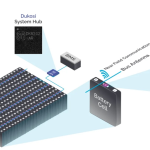
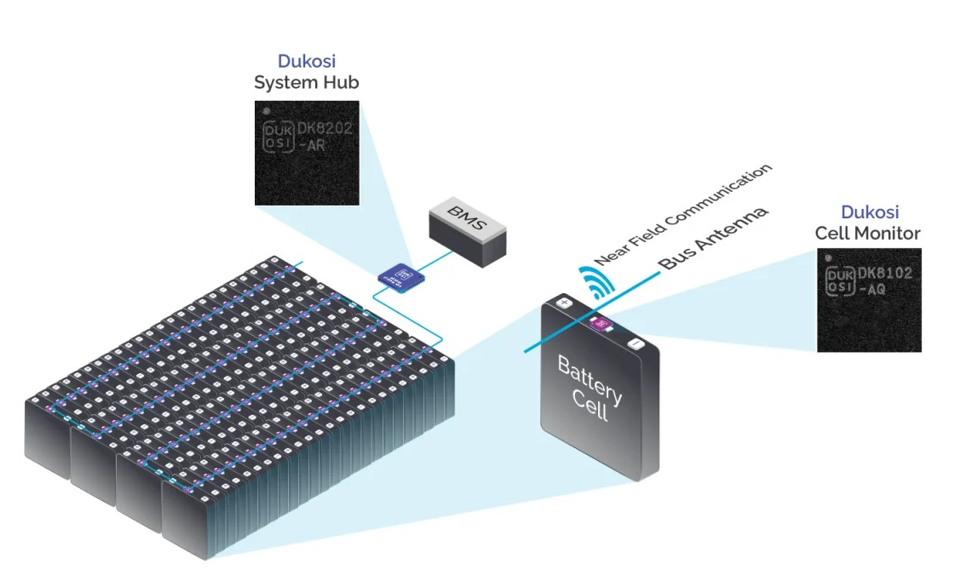
Dukosi has been working on a solution to address these limitations. It developed a “smart cells” architecture, the Dukosi Cell Monitoring System (DKCMS), based on an individual cell monitoring IC and a novel near-field communication bus. It is suitable for high-power battery packs that can contain hundreds or even thousands of cells.
The intelligence is brough to each cell through its own monitoring IC – the DK8102 Cell Monitor – a chip-on-cell technology that captures a cell’s individual voltage, temperature and critical operational data.
Each DK8102 is powered directly by the cell it measures. With very low quiescent current and flexible power modes, cells can self-monitor for potentially years, without a measurable effect on their performance or lifespan.
Temperature stability is equally critical. Each sensor is individually calibrated across a wide temperature range during production, and the devices have been qualified to various AEC, IEC, ISO and ASPICE quality and safety standards, for safety and reliability. This ensures consistent, predictable behaviour even as components age.
For data communication from cell to hub, the DKCMS uses a proprietary near-field communication protocol (C-SynQ). A single, low-profile antenna bus removes the need for complex, heavy wire harnesses to network the cells. It runs above each cell’s near-field antenna, providing kilovolts of electrical isolation, with very high EMI immunity and very low emissions. The system hub then aggregates and delivers the information to the BMS host with deterministic latency.
C-SynQ was designed from the ground up for large-scale, cell-level monitoring. It captures real-time data from each cell, synchronously and at low latency. It also allows packs of variable size to be configured without redesigning the communications layer, giving battery manufacturers greater flexibility.
The entire system captures accurate, synchronous measurements of voltage, temperature and usage for every cell, simultaneously, and stores a lifetime record of that data directly on the cell chip.
Common needs
From automotive to industrial and stationary storage, high-voltage batteries face distinct operational demands. Yet across all of them, performance, safety and manufacturability are made simpler with accurate, reliable and efficient cell-level monitoring.
While each DK8102 integrates a number of functions within a single chip, the overall system-level advantages enabled by DKCMS far outweigh the cost of implementation. By removing module-level boards, extensive wiring, additional protection circuitry and separate sensor systems, DKCMS cuts component count by nearly a factor of ten, whilst enabling more automated, repeatable pack assembly. For xEVs, that translates into simplified production, reduced weight and unparalleled flexibility for packaging, and for battery energy storage systems, it enhances scalability and long-term maintainability.
Furthermore, this embedded intelligence helps to support precise diagnostics, warranty tracking and compliance with regulations whilst simplifying second-life evaluation and recycling. Across applications, it turns each cell into a traceable, data-rich asset, thus enabling safer, more efficient and more sustainable battery systems.
Taking the initiative to lead the industry ahead of the European Battery Passport regulation, which takes effect in 2027, Kia Europe recently announced that it is the first OEM to publicly trial cell-level battery passport technology. In the trial, Kia equipped its EV3 with Dukosi Cell Monitors and explored opportunities using both static and dynamic data, such as SoH, with the aim of storing, accessing and tracking key attributes throughout the life of a vehicle battery. This will improve maintainability and repairability, while building trust in existing battery life and ultimately yielding higher resale value.
Manufacturers of automated guided vehicles and airport ground support equipment (GSE) are also under pressure to balance reliability, uptime and ease of maintenance with rapid development and cost efficiency. Smart charging technologies provider, Camy New Energy, has used DKCMS in its new battery pack for electric GSE vehicles. A contactless, cell-level approach shortens design cycles, enhances scalability and supports the high safety and reliability standards required in airport operations.
This demonstrates how a contactless, purpose-built approach can bridge the gap between new challenges and old technologies.
From industrial mobility to xEVs and BESS, DKCMS allows operators and designers to optimise battery packs for each application without compromising on efficiency or manufacturability, setting a new benchmark for high-voltage battery design in an increasingly demanding market.
By Joel Sylvester, Chief Technology Officer, Dukosi