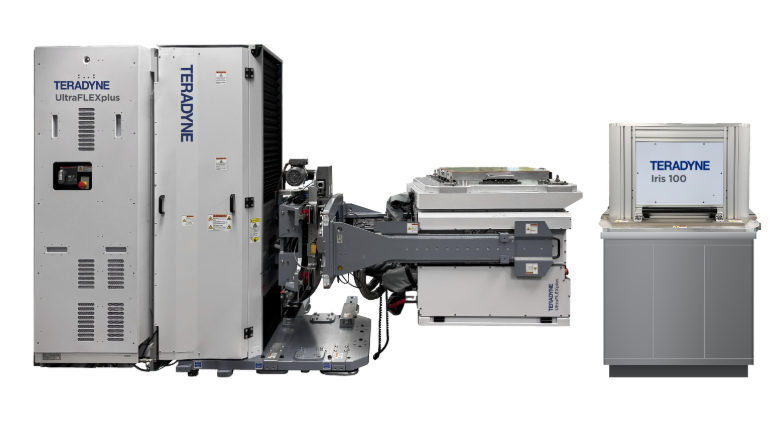
Automated test equipment provider, Teradyne, now offers Iris 100, a production-ready optical test platform for microLED devices.
Iris 100 brings semiconductor-grade optical test to microLED manufacturing, measuring every individual emitter in an array and integrating directly with the Teradyne UltraFLEXplus platform for combined optical and electrical test.
MicroLED technology underpins two of the fastest-moving areas in advanced electronics, augmented reality (AR) microdisplays and optical data interconnects for AI data center architectures. Both depend on devices that contain hundreds of thousands to millions of individual emitters, each of which must be characterized with production-level precision and throughput. Bench-top optical instruments can characterize these devices in the lab, but they cannot deliver the throughput and cost-per-unit economics that volume manufacturing requires.
“MicroLED is shifting from lab to volume production for both AR microdisplays and, increasingly, optical interconnects, which are becoming foundational to how AI data centers scale beyond copper,” said Shannon Poulin, president of the Semiconductor Test division at Teradyne. “Both technologies demand per-emitter test at production throughput, and Iris 100 delivers that today on test infrastructure our customers already run at scale.”
Teradyne Iris 100 was engineered for high-volume precision manufacturing with its spectrometer and high-resolution camera that measure the spectral response of the array, and per-pixel luminance and uniformity. Advanced test parallelization and image-processing algorithms enable characterization of a full array containing millions of microLEDs with high throughput. Leveraging Teradyne’s widely adopted IG-XL software, Iris 100 detects optical defects such as dead/stuck pixels and cluster defects early in the manufacturing process. Its NIST-traceable calibration workflow enables absolute measurements that correlate lots, wafers, and manufacturing sites.