
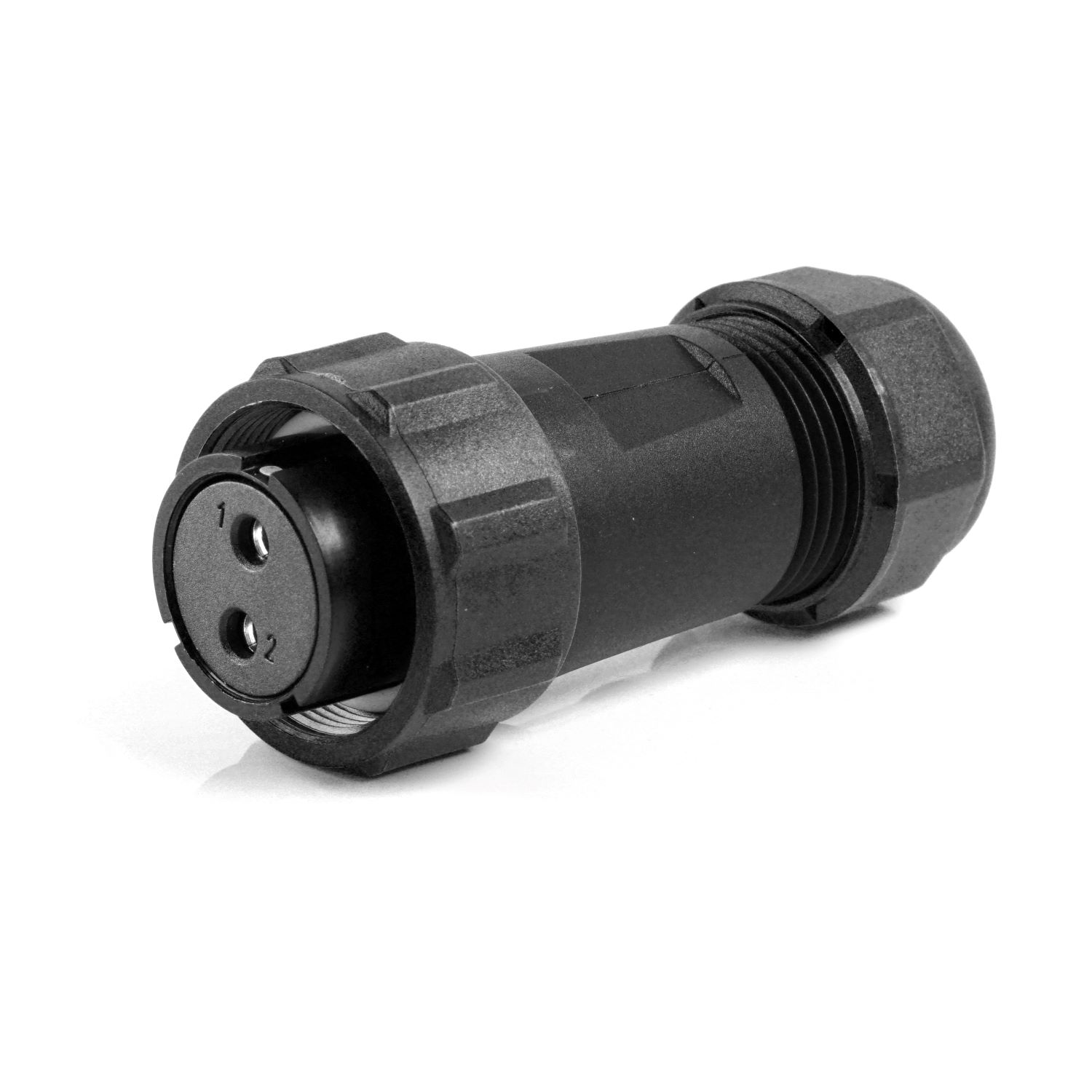
Almost every industrial electrical device, from the simplest adaptor to a complex automation system, uses some form of connector – a device that joins two electrical circuits. Current is transmitted via conductive contacts or pins, set in a protective housing that ensures the pins are electrically isolated whilst held in permanent alignment, enabling the connector to be repeatedly plugged and unplugged.
Industrial connector requirements
Industrial connectors will often have to comply with the safety, performance or regulatory standards governing a specific operating environment. Standards may apply to multiple industry sectors, such as those for ingress protection, or be sector-specific, for example ISO13485 for medical devices or MIL-std standards for defence equipment. In each case, connectors must perform reliably in different conditions, of which the most common include mechanical stress, the ingress of particles or moisture and electromagnetic interference.
Mechanical durability depends on the materials used to construct the connector, to provide physical strength and protect it against external damage. Industrial connectors are normally manufactured from plastics, metal or a combination of the two.
High-volume products are injection moulded using polycarbonate (PC), acrylonitrile butadiene styrene (ABS) or polyethylene terephthalate (PET) to provide impact resistance, with elastomeric polymers sometimes being added to improve durability. Polycarbonate blends are widely used for low-voltage connectors, as their high mechanical strength, flame retardancy and heat resistance combine with in-mould viscosity and flow characteristics.
Correct choice of material is also important for electrical contacts, for optimal signal transmission, yet resistant to vibration and wear that arises from repeated mating cycles. Materials include brass and beryllium copper, of which the latter provides the best combination of mechanical and electrical properties. For specialised applications, contacts can be plated with a thin layer of platinum, palladium, gold or silver alloys to improve electrical properties and enhance resistance to wear, oxidisation and corrosion.
Gold is more conductive than silver and is generally chosen for connector pins where low electrical resistance is critical. It’s worth noting that environmental conditions can cause oxidisation of the surface of silver contacts, which in severe cases can increase the resistance of the circuit, reaching a stage where there are intermittent faults or a complete loss of signals.
Similarly, the shape of connector pins needs to be considered to ensure the best possible signal transmission, whilst eliminating stress points that may fail through repeated mating cycles.
Vibration can be a particular problem. It can cause mechanical connections to fracture, component parts to become misaligned, intermittent signals to be generated by pin connections and fretting to occur, where wear takes place between loaded contact surfaces.
The solution is either to use flexible terminations, allowing sufficient free movement to absorb vibrational movement, or to fit anti-vibration plates, isolators or dampers. Additionally, there are connection devices available with anti-vibration or locking mechanisms; these are ideal for robotic systems where excessive flexing presents a risk of cable pull-out.
One of most common requirements for connectors is the need to protect them against the ingress of particles and moisture. Connectors typically use cable glands and rubber seals, or silicone sealing materials, to enable them to meet IP standards. Further options include potting, where components are encased in epoxy resin, or the use of over-moulding either of individual connectors or the entire device.
A similar approach is taken if electronic devices need to have gas-tight or explosion-proof connections where, for example, screw-threaded or bayonet coupling mechanisms, or specialised glass-to-metal or ceramic-to-metal insulators are used to provide optimal protection.
Extremes of temperature can be a particular problem, as expansion and contraction can cause connector pin contacts to loosen, whilst both extreme temperatures can adversely affect material properties. Temperatures above +150°C weaken and distort the plastics, whereas temperatures below -55°C make them brittle and prone to cracking. The solution is to choose connectors manufactured from either specialised plastics or metal parts.
Materials used in connectors will also need to comply with fire standards such as ISO 834-1 or be manufactured from flame resistant low-smoke-zero-halogen (LSZH) plastics to meet the requirements of UL94V-0. LSZH compounds are widely used for cables and connectors in poorly ventilated areas as they don’t release toxic hydrogen chloride gas in the event of a fire; this gas reacts with water to form hydrochloric acid.
In hazardous areas
In hazardous areas, where the presence of gasses, dust or petroleum products create the risk of explosion, connectors must be specified to minimise the potential for an electrical spark and to prevent a rise in the surface temperature of the component.
These intrinsically safe devices must comply with the requirements of the UL, ATEX or IECEx standards, and work with low-voltage circuits, to minimise the electrical energy potential. Connectors can be fitted with intrinsically safe seals and cable glands to isolate the device from the surrounding atmosphere, or be specified either as part of resin encapsulated arc-producing elements, or within explosion proof enclosures.
Electromagnetic interference that originates from radio transmitters, mobile phones, electric motors, power cables or lightning and solar magnetic storms can also be a problem.
EMI is mitigated by the use of shielding around the emitting device or within the overall product enclosure. Shielding can take the form of a solid metal cover, wire mesh with the openings matched to the wavelength of the emissions, or the use of silicone-metal paint within the enclosure. However, for enclosures with openings for cables or displays it is necessary to use filtered connectors, such as a filtered D-sub; these incorporate low-pass filters to allow low-frequency currents and signals to be transmitted without degradation, while attenuating the high-frequency EMI wavelengths.
Choosing the right connector
Choosing the correct rugged electronic components can be complex as there are many variables in terms of both component specification and regulatory compliance, all of which need to be given careful consideration. This is where working with an expert supplier of rugged electronic components is crucial, as they will be able to provide the specialised knowledge and access to the most appropriate connector products.
By Luke Hartley, Managing Director, Live Electronics