

For decades, manufacturer websites have been the primary source of truth for electronic component selection. Engineers rely on them for datasheets, CAD models, application notes, compliance documentation, and cross-reference guidance. Yet despite this central role, most engineers still struggle to locate even basic information quickly. The culprit is the same across nearly the entire industry: traditional parametric search.
Parametric search was designed for an earlier era, when product lines were smaller, documentation was simpler, and engineers primarily needed to filter known parameters. It relies on structured attributes, exact matches, and clean data. When an engineer already knows the voltage, package, tolerance, or isolation rating they need, parametric filters can work well.
But today, design rarely starts with complete information. Engineers ask questions like:
- “Low-profile DC-DC modules under 20W that can start at -40°C.”
- “Connectors with locking mechanisms suitable for handheld medical devices.”
- “A drop-in replacement for a logic family when moving to 3.3V.”
Parametric search cannot interpret these queries. At best, engineers get thousands of loosely related results; at worst, they get none at all.
Compounding this, most product knowledge does not live in a structured database. It lives in PDFs, drawings, app notes, tables, blog posts, CAD metadata, long-form engineering notes and, increasingly, inside the heads of a few “oracle” employees at every company. Parametric search cannot read these documents, let alone understand them.
Meanwhile, outside of engineering, AI-driven natural-language search has already become the norm. Consumer platforms like Amazon, Netflix, and Walmart have all shifted to AI-first discovery experiences — and engineers now expect that same experience when searching for technical content. The gap between expectation and reality on most manufacturer websites is widening.
Why traditional search fails modern engineering workflows
The strengths of parametric search have become its limitations. It excels at filtering tabular data, but only when the user already knows the parameters and when those parameters are consistent across products. Engineering language, however, is full of shorthand, synonyms, and variations: SOIC vs. SO-8, “startup voltage” vs. “turn-on threshold,” package families, tolerances, and incomplete part numbers. Small inconsistencies can break the search entirely.
Worse, engineering content is spread across multiple disconnected systems: PIM and ERP tables, PDF libraries, SharePoint folders, application-note repositories, CAD servers, and distributor inventory systems. Because parametric search can see only one of these, engineers end up manually hunting across tabs, downloads, and folders to piece together information that should be unified.
This friction slows design cycles and increases reliance on customer service and FAE teams for questions that should be answerable instantly.
What AI search does differently
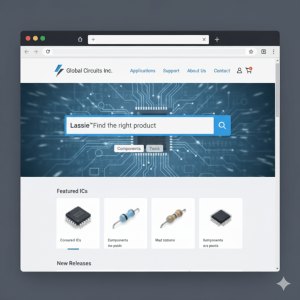
A new category of AI-driven search tools is emerging to address these problems. One example is Lassie, a domain-trained site-search engine developed for the electronic components industry. While implementations differ across manufacturers, the underlying approach represents a meaningful shift in how engineers interact with technical content.
Understanding engineering language
Unlike general-purpose AI, domain-specific models are trained on electronic component terminology and manufacturer content. They recognize package families, interpret partial part numbers, handle typos, and understand phrasing like “high-side current sense under 80V.” This allows engineers to search the way they think, instead of the way a database demands.
Unifying all content types
AI search layers index structured and unstructured data together: product databases, datasheets, CAD files, application notes, compliance documents, videos, blog posts, and, when provided, distributor inventory. Engineers get one coherent result set instead of a fragmented trail of documents.
Interpreting intent, not keywords
AI models evaluate the meaning behind a query. Instead of producing either thousands of hits or none at all, they return tightly relevant results and provide links to the exact documents the answer came from. Anchoring responses to approved manufacturer materials keeps guidance accurate.
Enabling insight back to the manufacturer
When engineers request emailed results or ask follow-up questions, those interactions can be routed into CRM systems via API or platforms like Zapier. Manufacturers gain visibility into what customers are researching — something traditional search cannot reveal.
AI support tools: Reducing FAE load without replacing expertise
Improving site search solves one half of the problem. Engineers also need help interpreting product data, comparing options, and understanding trade-offs. This is where virtual engineering-support tools, such as Laifae, a virtual field applications engineer, are beginning to complement search systems.
These tools are trained on manufacturer documentation, application notes, and product knowledge. They can explain parameters, compare families, summarize content, or produce tables that organize specifications.
When a question requires expert judgment, the AI can escalate the interaction and pass the transcript or relevant details into the CRM so a human FAE can respond with full context. The result is less repetitive work for FAEs and faster answers for engineers.
Why AI is becoming essential infrastructure
AI-powered search and virtual support do more than improve usability. They allow engineers to interact with technical content naturally through questions, comparisons, and contextual reasoning. They reduce the time spent hunting through PDFs or waiting for responses, and they give manufacturers a more accurate picture of what customers actually need.
Traditional parametric search will continue to have value, but it can no longer meet the demands of modern engineering workflows on its own. Tools like Lassie and Laifae illustrate how domain-trained AI can unify fragmented documentation, interpret engineering intent, and deliver reliable, document-anchored guidance.
As the volume and complexity of engineering content continues to grow, AI-driven discovery and support will move from helpful upgrades to expected infrastructure — an integral part of how component manufacturers serve the design community.
By Graham Kilshaw, CEO, Lectrix and Johnathan Parker, Vice President of Consumer Success, Orbweaver