German consortium QuINSiDa has achieved a major step towards mobile quantum-secure communication, by demonstrating a one-of-a-kind free-space data transfer channel with Li-Fi and QKD implementations.
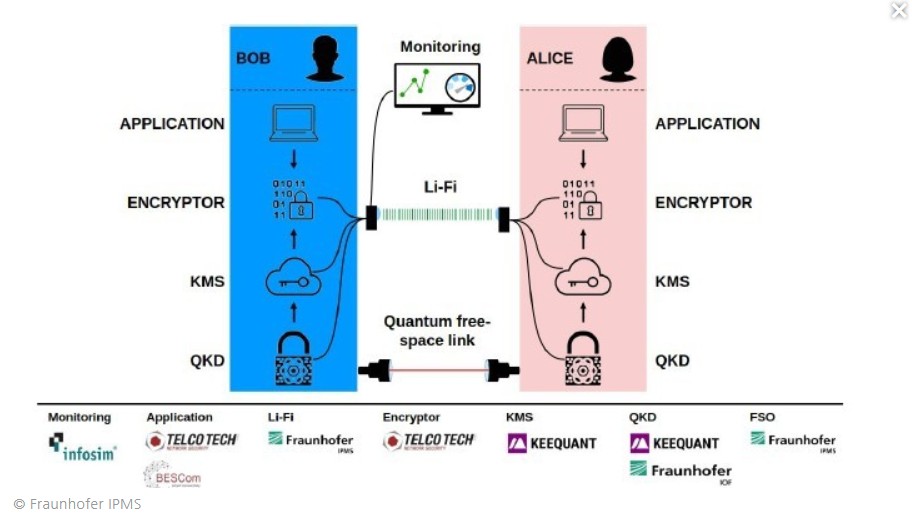
This is the first time Li-Fi and major quantum key distribution (QKD) have been combined in an architecture that enables quantum-secure key delivery without relying on fibre or radio. The solution integrates key management (KMS), encryption and monitoring, and opens up new possibilities for high-security networks where flexible infrastructure is desirable.
So far, most quantum communication systems depended on dedicated fibre networks, limiting their flexibility. QuINSiDa has now demonstrated an integrated optical-wireless quantum security stack in the laboratory, combining free-space Continuous- and Discrete-Variable QKD (CV/DV-QKD) with Li-Fi and connecting the result to key management, encryption and monitoring. The setup operates over a line-of-sight optical link, enabling quantum-secure key distribution for civil critical infrastructure applications, including maritime and harbou connectivity, industrial campuses, aviation, automotive environments, temporary secure networks and fixed-to-mobile links. The design allows to conveniently deploy and monitor the system while remaining compatible with existing security workflows.
The breakthrough lies in a combination of Li-Fi and QKD that enables line-of-sight communication. In this approach, Li-Fi and QKD are integrated into the same wireless environment. This includes continuous-Variable QKD at 1550nm, discrete-variable QKD at 810nm and Li-Fi in the 850-940nm range.
Wavelength separation and optical filtering allow all three to operate simultaneously without disturbing each other. In the integrated system, the QKD post-processing data is transmitted over the Li-Fi link rather than in a dedicated channel. The Li-Fi connection thus forms the only channel for classical communication, which is an advantageous simplification.
Maintaining a stable free-space optical link requires precise alignment, which the QuINSiDa system achieves by using a Pointing/Acquisition/Tracking (PAT) subsystem. Li-Fi supports endpoint identification/localization and provides a feedback channel, enabling PAT to acquire and maintain alignment for the quantum link. The project implemented a coupling/interface concept that can serve both CV-QKD and DV-QKD while preserving the signal properties relevant to QKD. PAT control and telemetry are fully integrated into the overall communications flow.
With this achievement, Germany steps closer to a future where quantum-secure communication is moving towards mobile security applications, that can be deployed wherever optical wireless links are feasible. This brings quantum-secure encryption into real-world operations and offers a powerful tool for securing critical infrastructure.
The QuINSiDa consortium consists of six partners: KEEQuant GmbH (coordination; CV-QKD, key management integration), Fraunhofer Institute for Photonic Microsystems IPMS (Li-Fi and free-space link components; PAT), Fraunhofer Institute for Applied Optics and Precision Engineering IOF (DV-QKD contribution), Infosim GmbH & Co. KG (monitoring/network management system integration), TELCO TECH GmbH (encryption integration), and BESCom Elektronik GmbH (use-case, transfer and dissemination).