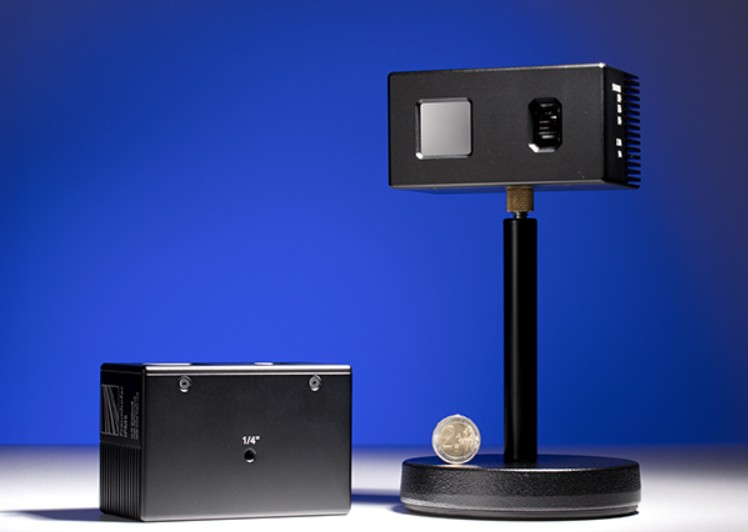
Fraunhofer IPMS is introducing a new technology called Li-Fi Grathus, which transmits data via light instead of cable or radio waves. The system delivers gigabit-speed performance and can send and receive data simultaneously. It operates reliably and with near-zero latency, even in environments where traditional wireless systems reach their limits. Thus, Li-Fi Grathus enables flexible and reliable communication at the speed of light.
Li-Fi (from Light Fidelity) uses light signals instead of radio waves, giving it a key advantage: immunity to electromagnetic interference (EMI), which is common in industrial environments. The system also supports full-duplex communication, transmitting and receiving simultaneously, which ensures uninterrupted data flow and prevents any time loss. A key advantage is its extremely short and predictable delay, also called deterministic latency, of less than 100ns. This allows for truly real-time data transmission, which is crucial for robotics and precise machine control.
Li-Fi Grathus was developed by the Fraunhofer Institute for Photonic Microsystems IPMS.
“The Li-Fi Grathus builds on more than 15 years of Li-Fi expertise at Fraunhofer IPMS. Our latest development provides fast, secure, real-time optical wireless communication for industrial applications and is compatible with numerous industrial Ethernet standards. Its robust design makes it ideal for demanding industrial environments,” said Dr. René Kirrbach, Group Leader for Li-Fi at Fraunhofer IPMS.
The system can be seamlessly integrated into existing systems and networks without major modifications and supports common industrial standards, such as Profinet, EtherCAT, EtherCAT G, SERCOS III, and the new Time Sensitive Networking (TSN). In addition to Ethernet and Gigabit Ethernet, it supports USB 3.0/3.1 and customer-specific interfaces. An additional side channel with 1 Mbit/s supports management, diagnostics, and safety signals.