In a world demanding cleaner, smarter and more efficient technologies, energy has become the common thread pulling together innovation across multiple industries. Whether on the ground in electric vehicles (EVs), soaring through the skies in next-gen aircraft or even orbiting the Earth aboard space missions, energy systems are evolving, and at the heart of many of these lies chemical etching.
Chemical etching might not grab headlines, but it’s quietly powering some of the most advanced technologies around — from satellites to hydrogen fuel systems. By using controlled chemical reactions to remove metal with pinpoint precision, it creates complex components that traditional methods like stamping or laser cutting can’t match. And, as demand for high-complexity components rises, etching is stepping into the spotlight. This shift is most visible in energy systems across many sectors.
For example in autonomous vehicles, etched copper busbars are being used in the battery packs of autonomous robo-taxis in the US. These packs sit under the passenger seat, with rows of AA-sized cells connected by precisely engineered busbars featuring break points that isolate failures and prevent full-pack shutdown.
Although a little behind, the UK plans a rollout of self-driving taxis following the Automated Vehicles Act taking full effect in late 2027. This calls for thousands of parts produced in moderate volumes, all within tight turnaround windows and changing specs. Chemical etching shines here, offering speed, precision and flexibility. While these vehicles may move to high-volume stamping processes later, etching helps in the early stages where design isn’t yet locked.
And there’s a wider trend to acknowledge, the technology used in an autonomous vehicle’s battery is structurally similar to that used in satellites. The context shifts, but the engineering need remains constant to connect, conduct and control power.
Hydrogen and electric
Electric vehicles and hydrogen fuel systems are often seen as competitors, but the reality is they are complementary. For example, the European International Council on Clean Transportation (ICCT) highlights that hydrogen fuel cell vehicles (FCEVs) could soon outperform EVs in emissions reduction, provided they run on renewable hydrogen.
The study suggests FCEVs could emit 79% fewer emissions than internal combustion engine vehicles over their lifetime, which is slightly better than battery EVs using renewable electricity. This, however, does not mean that hydrogen will entirely replace battery-electric vehicles, it’s more likely to be a combination of the two. EVs will most likely dominate the passenger car market, whereas hydrogen will likely lead in heavy-duty transport, long-haul logistics and commercial fleets, where it is currently gaining momentum.
Yet, behind both technologies are systems built around connectivity — in particular, energy. Battery packs, fuel cells and heat exchangers rely on etched components like busbars, bipolar plates and printed circuit heat exchangers to deliver power and handle the thermal requirements. In hydrogen, this might involve supplying plates for electrolysers that generate hydrogen, or the heat exchanger flow plates that help compress and dispense it into a truck. The same principles apply inside the vehicles and aircraft, whether hydrogen-powered or fuel cell driven.
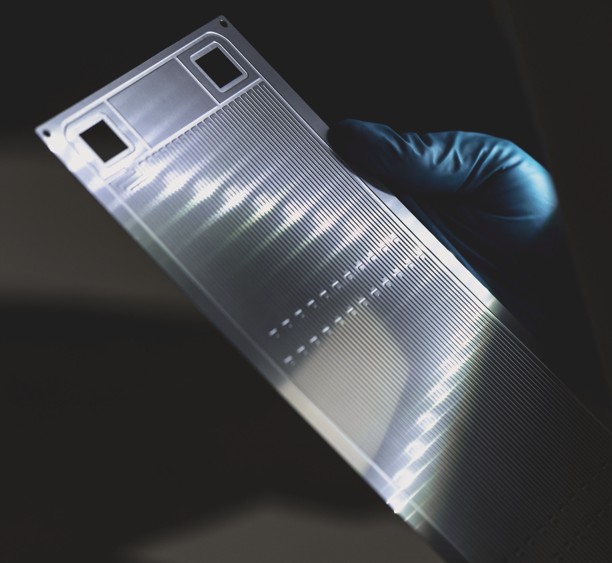
In aircraft, thermal management is a crucial area of focus. Compact aluminium heat exchangers rely on etched aluminium flow plates used in aircraft engines to manage cooling airflow with higher efficiency. These plates, with their intricate channel designs, are evolving into fuel cell bipolar plates in hydrogen systems.
Etching has long played a role in combustion-era automotive manufacturing, from injector components to under-the-hood systems. Now, the same processes enable fuel cells, EV battery connections and the entire hydrogen ecosystem. Whether electric or hydrogen-powered, vehicles using these technologies are beginning to prevail, with a blend of legacy and future-facing technologies, albeit with much cleaner and more efficient systems.
New frontiers
Apart from on the road and in the skies, we are seeing many projects heading to deep space. Recent surveys suggest a boom in space missions from both public agencies and private operators, which is creating a growing demand for small but vital components like thin, etched nickel interconnects used in lithium-ion batteries for satellites and exploration vehicles sent to study exoplanets. Such components must operate in the extreme conditions that we do not experience here on Earth.
One well-known project is the Mars Rover, a remote-controlled robotic vehicle that was sent to Marsh to explore its surface, which will be complemented by the 2028 ExoMars mission, aimed at finding signs of past life on our closest neighbouring planet.
What might appear as simple components for these missions are anything but, requiring specialist materials that must be processed quickly, flexibly and with precision. Chemical etching here allows for rapid design changes and keeps tooling costs low, making it a perfectly suited discipline for high-precision work where there’s no room for error.
A cross-sector reality
Analysing all these trends leads us to conclude that we are seeing sectorial convergence. Energy systems in space, air, land and sea are being determined by the same fundamental forces, which are the demand for cleaner power, the need for agility in design and the pressure to deliver quickly.
Chemical etching supports rapid prototyping, delivers precision and can be applied to a wide range of materials, making it the perfect solution in this complex and fast environment created by modern engineering.
From pure nickel in satellites to copper in EVs and specialised alloys in space-grade systems, the process adapts across applications whilst keeping outcomes consistent.
Energy is the thread connecting progress across multiple applications, whether that’s orbiting satellites or on-road innovation. After all, the future isn’t just on the horizon — in many cases, it’s already in production.
By Ben Kitson, Head of Business Development, Precision Micro