At first glance, railways seem to have nothing in common with medical technology. When people think of railways, they usually associate them with speed and scale, but also with harsh environmental conditions involving a lot of dust, rain, or heat.
When it comes to medical technology, however, people tend to think of bright, clean and sterile environments, precision and reliability. So why do so many manufacturers of medical and laboratory equipment still rely on the expertise and embedded hardware of one of the leading technology companies in railway engineering? There are several good reasons for this.
Extensive experience with embedded hardware in a regulated environment
“That’s usually the first question I get,” laughs Dr Markus Jungmann, Director of Sales for Medical and Embedded at duagon.
Whenever he meets with OEMs and manufacturers of medical and laboratory equipment who aren’t yet familiar with duagon – or only know duagon from the rail industry – he has been asked: “How do the rail industry and medical technology fit together?”
My answer is always: “Perfectly! That’s why we’ve been reliably supplying major medical device manufacturers with embedded hardware for 20 years.”
duagon was founded over 30 years ago, with headquarters in Switzerland. Since January 2026, the company has been part of Knorr-Bremse based in Munich, Germany. Its origins and primary revenue lie in the rail sector, where duagon ranks among the world’s leading technology companies.
What began with interface cards for expanding embedded hardware has grown into a broad portfolio of hardware for train communication and computing, along with accompanying software and engineering services. duagon offers computing hardware for every railway application – both on board and along the tracks: comfort systems, functionally safe systems, complete systems, subsystems and components.
All products meet the strict regulatory requirements of railway technology and are specifically designed for the particularly harsh environmental conditions, to withstand vibrations, shocks, dust, moisture and extreme temperatures. In addition, they feature cybersecurity functions such as secure boot and secure updates to achieve defined security levels.
How medical technology benefits from railway technology
“The requirements in medical technology are very similar,” explains Dr Jungmann.
This applies to regulatory requirements, required reliability, long lifecycles, high performance computing capacity and environmental conditions. Mobile ventilators, for example, which are used by emergency medical services, must reliably withstand extreme conditions. They can fall anywhere at any time, get wet, or be exposed to direct sunlight, and must always function reliably despite shocks, vibrations and electromagnetic radiation in ambulances, helicopters, and even airplanes. The same applies to many devices in medical offices or clinics.
“Only a few manufacturers can produce computing hardware at such a high level. For us, however, it’s part of our daily routine,” says Dr Jungmann.
Comprehensive computing portfolio for all types of medical devices
duagon offers a variety of embedded and computing hardware for medical and laboratory equipment. Systems used in intensive care, such as ventilators, dialysis machines, infusion systems, anaesthesia machines, patient monitors and defribrillators, require robust, reliable and compact embedded hardware without its own housing. This is why Embedded System Modules (ESM), COM Express modules and Field-Programmable Gate Arrays (FPGA) are particularly well suited for these applications.
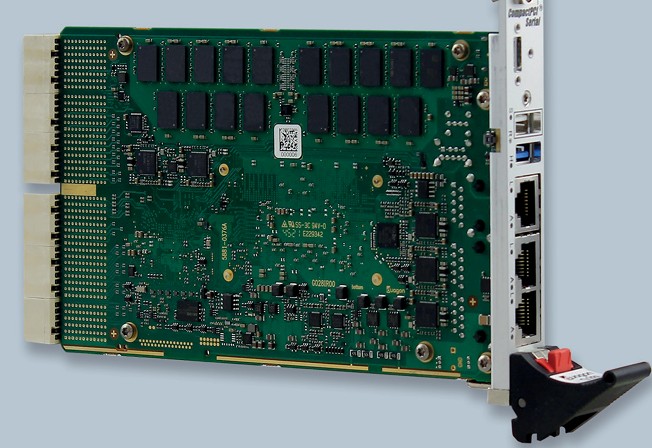
For large-scale equipment such as surgical robots, MRI or CT scanners, modular computing systems – for example, based on CompactPCI Serial – are available. They are characterised by high maintainability, versatile configuration options, and, when needed, enormous computing power.
All duagon products can operate without fans – an important consideration both in terms of hygiene in sterile environments and in terms of reliability. Another major advantage is that duagon offers standard products in its portfolio but can flexibly adapt them to customer requirements, even for medium-volume orders. Hardly any other manufacturer of embedded hardware offers similar flexibility or has comparable experience. This reduces development costs and time while also providing the highest possible flexibility in product design.
Standards-compliant hardware development and product maintenance
There are further overlaps between the railway and medical technology sectors in terms of the high level of regulatory requirements and certification procedures for safety-critical applications.
“That’s part of our daily routine,” says Dr Jungmann. To date, duagon has primarily supplied large medical device manufacturers, “who audit us and integrate us into their processes”.
To make itself attractive as a development partner and supplier to small and medium-sized OEMs and device manufacturers as well, duagon is aiming to obtain ISO 13485 certification for its quality management system this year.
“We know how complex it is for OEMs and device manufacturers to outsource development services to partners like us.”
duagon already provides documentation for approval by notified bodies alongside its embedded hardware – namely, design and development documentation, declarations of conformity, risk management documentation in accordance with ISO 14971, or any software documentation in accordance with IEC 62304. This also includes the results of various test reports, such as electrical and electronic safety tests in accordance with IEC 60601 or EMC tests.
“With the ISO 13485 certificate, we aim to build further trust among our customers in our 20 years of expertise in medical technology and in all these standard processes.”
This also includes the routine management of product lifecycles that are longer than average.
“Established and certified systems often remain in operation for several decades in both medical technology and railway technology,” confirms Dr Jungmann. Changes or new developments are complex, cost intensive, and usually require new approvals. However, because laws and regulations change simultaneously (e.g., regarding cybersecurity), technologies continue to evolve, and suppliers of individual components (e.g., CPUs, RAM, memory, etc.) switch to new product lines, changes must occasionally be made to existing hardware designs. “We have a corresponding lifecycle management system in place that allows us to offer above average delivery times and, if necessary, notify customers of required changes well in advance.”
Hardware solutions from duagon for medical and laboratory equipment include:
• Embedded System Modules (ESM)
• COM Express Modules (COMe)
• Modular, high-performance computing hardware
(e.g., based on CompactPCI Serial)
• FPGA programming
• System-on-Chip
• Microcontrollers
• Board Support Packages
• Compliance with standards (including IEC 60601)
• Extremely rugged hardware for demanding environmental
conditions: Vibration, shock, dust, humidity, extreme
temperatures
• Support services for exceptionally long lifecycles
Image shows the G029, which is a high-performance single-board computer compliant with IEC 60601. It is part of a modular CompactPCI Serial system that allows customers to assemble the right hardware platform from a variety of boards.