
Applications like embedded motion and robotics require powerful embedded drives that must function in constrained spaces. To meet the needs, servo drives are getting smaller; however, the power requirements are not closely aligned.
Important roles
Compact, powerful and embedded servo drives play a particularly important role when it comes to robots, which are increasingly taking centre stage across many industries. In healthcare they enable new, state-of-the-art surgical and diagnostic practices. They also play an important role in semiconductor manufacturing, for their ability to handle small, delicate parts and complex assemblies with high levels of precision and cleanliness. And in the world of logistics, mobile robots can navigate warehouses and distribution centres autonomously, streamlining operations and accelerating order fulfilment.
Other important industries for embedded servo drives include aerospace, lab automation and biomedical equipment, which often involve automated guided vehicles (AGV), autonomous mobile robots (AMR) and other complex systems that handle and transport objects, navigate the environment to fulfil various tasks.
Yet for all the innovations happening in the world of automation, the compact servo drives behind these sophisticated systems must be able to meet a combination of requirements related to motion control, size and power, including:
- Providing high positional accuracy and repeatability.
- Achieving excellent dynamic performance, including smooth motion profiles, fast response times and precise speed and torque control.
- Supporting real-time communication protocols, such as EtherCAT, to ensure reliable communication between the drives and control system.
- Featuring a compact size for mounting onto the motor itself or within the robotic joint.
- Packing enough power, despite their small size, to move the robotic arm, AGV or AMR with utmost reliability and efficiency.
Meeting all these requirements is easier said than done, however. Designing powerful, miniaturised servo drives that can perform within the tight confines of robotic joints, AGV chassis and other embedded motion control applications presents several design challenges, not the least of which is thermal management.
Staying cool
As servo drives shrink, their surface area available for heat dissipation shrinks too, making thermal management progressively more challenging. Fortunately, there are design principles that together can maximise the efficiency of even the smallest embedded drives. Our Nano embedded servo drives exemplify these principles to deliver industry-leading power density and efficiency (> 99%), which manages heat and electromagnetic interference (EMI), and supports size reductions.
Circuit materials: The first and most obvious heat dissipation solution involves an upgrade to the drive’s circuit board materials. The Nano drive, which consists of a four-board PCB stack, uses a single-sided board with a copper-alloy substrate (TClad). This board, which handles power for the device, would traditionally have had an aluminum substrate, but the switch to the proprietary TClad copper alloy resulted in a threefold improvement in thermal conductivity.
Custom components: Another solution involves custom-designed components for increased heat dissipation. For example, the Nano features custom-designed pins to carry current out of the drive. Not only are these pins smaller than a standard connector, but they are also designed to conduct heat away from the drive.
Dynamic gate drive tuning: The output stage consists of two key components – the gate drive integrated circuit (IC) and metal-oxide-semiconductor field-effect transistor (MOSFET) – both of which are standard, off-the-shelf components used used by all key players in the motor drive world. To maximise the Nano’s thermal-management capabilities, we make critical design decisions during their selection process:
- The gate driver IC: We select compact, half-bridge drivers with high output current capabilities. Because the output current limits the size of the usable output-stage MOSFET, it is important that the drivers have high-current capabilities.
- The output stage MOSFET: These components must feature a small package, low thermal resistance, high current and low drain-source on resistance (RDS(on)).
In terms of thermal management, the magic happens in between these two components. Dynamic gate-drive tuning controls the timing between the power device turn-on and turn-off to achieve low power dissipation whilst meeting electromagnetic compatibility (EMC) requirements.
Current sensing: To further reduce heat dissipation, the Nano features some clever methods for measuring current. This novel approach to current sensing uses ultra-low-resistance current sense resistors, enabling precise current sensing with minimal power dissipation.
Finally, the smallest, most-powerful servo drives also need to apply other strategies to minimise heat build-up. In the case of the Nano, these include the overall construction and layout of power components on the board. We can also pull a number of levers within the drive’s firmware to further reduce dissipation, if required. For example, one feature – called bus clamping – effectively reduces switching losses by as much as 33%.
At the end of the day, managing the heat on the smallest, most-powerful drives doesn’t come down to a single design principle. Instead, it’s the sum of many small, carefully-considered design decisions.
Best-in-class power dissipation
Figures 2-4 show the power dissipation in our NES-090-70 and NES-18-10 Nano drives when the pulse-width modulation (PWM) outputs are driving the motor. Adding the PWM dissipation to the Vlogic dissipation yields the total dissipation in watts for the drive.
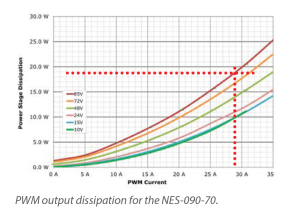 figure 2
 figure 3
For the NES-090-70, the dotted lines show a dissipation of 18W at a continuous current of 28Adc and +HV = 85Vdc. For the NES-18-10, the dotted lines show a dissipation of 5.2W at a continuous current of 4.4Adc and +HV = 180Vdc.
Relevant for all NES models, Figure 4 shows the power dissipation in the Vlogic circuits that power the drive’s control circuits and external encoders. Adding the PWM dissipation to the Vlogic dissipation yields the total dissipation in watts for the drive. The dotted lines in the chart show a dissipation of 3.0W at Vlogic = 30Vdc when the drive is in an enabled state and outputting 250mA for an encoder.
 figure 4
The Nano Series digital servo drives
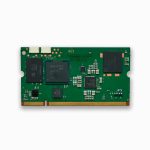
An example of a servo drive that incorporates the right power density and thermal management features is our Nano Series. Each compact unit integrates easily into AGVs, AMRs, robotic joints and other automated equipment. Designed for space-limited applications that need precise speed and position control, the Nano Series represents the next generation of motion control technology, enabling users to achieve unparalleled accuracy and efficiency in their applications.
The Nano Series comes in a small footprint of 35 x 30 x 23.4mm, operates from 9-180VDC input voltage and delivers up to 35A of continuous current and 70A peak current to provide exceptional power density and efficiency. Its compact size also gives integrators the flexibility to mount units directly onto the motor or within robot joints. The optional connector-equipped PCB and CME commissioning software facilitate setup and tuning.
Additional features and specifications include:
- Safe torque off capability with Sil 3, Category 3, PLe conformance;
- Six digital inputs and four digital outputs;
- Four voltage and current combinations;
- One ±10-volt (V) 12-bit analogue input;
- BiSS-C unidirectional and SSI absolute encoders (primary);
- Digital incremental encoder (primary and secondary);
- Frequency analysis tools;
- Dual encoder feedback support;
- 32-bit floating-point filters and other, advanced filters.
In addition, the Nano Series supports EtherCAT or CANopen communication protocols, enabling real-time data exchange. Nano Module EtherCAT NES and Nano Module CANopen NPS models are available with an EZ Board option to simplify mounting.
By Dean Crumlish, Product and Applications Manager, Copley Controls