
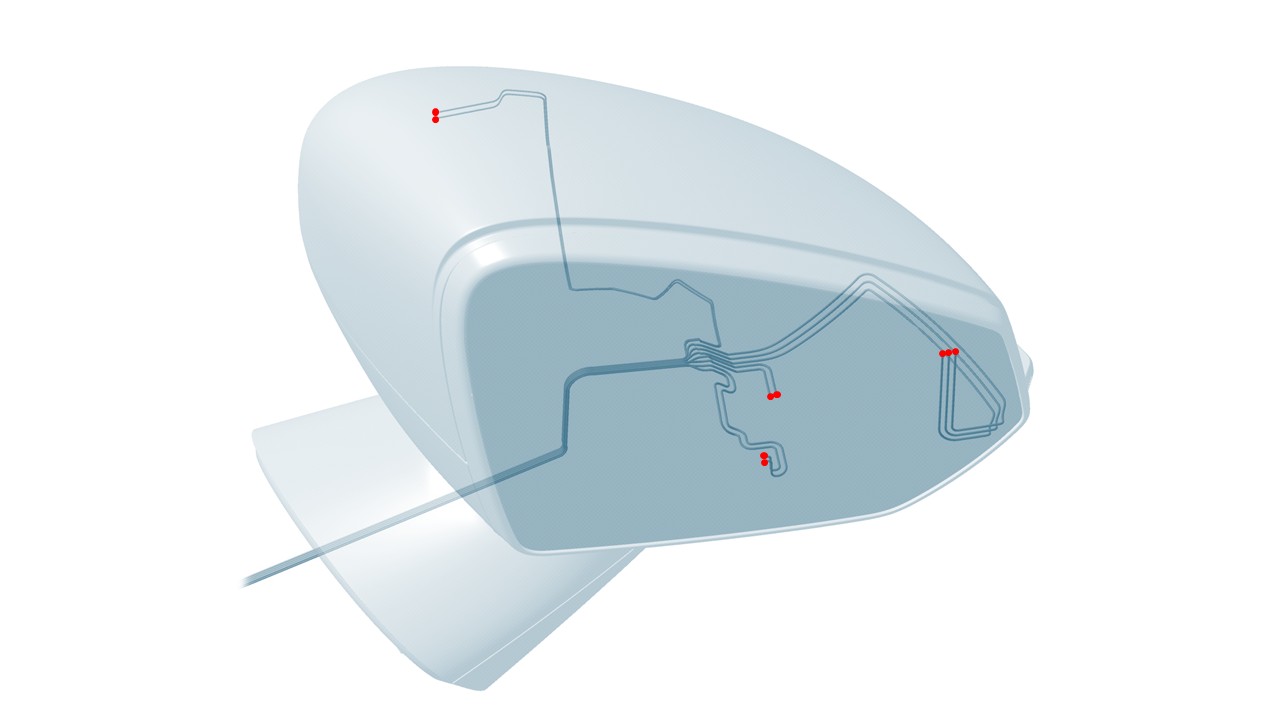
A collaborative project between Bristol-based manufacturer of robotic cells, Q5D, Samvardhana Motherson Reflectec (SMR) UK plant and Cranfield University will develop next generation exterior automotive mirrors under the UK government’s £4bn DRIVE35 programme. The focus is on creating a “Mirror 2.0” concept that integrates an automatic wiring harness into an increasingly complex mirror assembly while improving efficiency, manufacturability and robustness.
Q5D will contribute its wiring automation technology and design expertise to help SMR integrate wiring directly into the mirror’s structure. The partners will run a series of joint design workshops in which SMR iteratively refines the mirror design, and Q5D proposes options for routing and securing the wiring to suit automated production. This phase will culminate in a demonstrator mirror manufactured in the UK that embodies the new electrical and electronic content alongside Q5D’s automated wiring approach.
Exterior mirrors now combine multiple functions in a small volume, including mirror actuation, heating and a growing range of sensors and lighting features. Fitting the associated wiring into this constrained space using manual methods is becoming increasingly challenging and labour intensive. By automating the manufacture and integration of the wiring harness, Q5D aims to support SMR in reducing manual handling, improving repeatability and helping to keep advanced mirror manufacturing in the UK.
The project is structured in stages in line with the government funding. The initial Demonstrate 35 phase focuses on producing a proof-of-concept mirror. If successful, SMR and Q5D expect to participate in follow-on funding aimed at scaling the process to higher volumes. SMR will carry out environmental and functional testing of the prototype mirrors using its in-house facilities, while Q5D will manufacture the automated wiring harness components and support integration.
Compliance with relevant automotive wiring and connector standards, including commonly referenced specifications such as USCAR, will be addressed as SMR and Q5D refine the design and validate the technology. The collaboration builds on Q5D’s experience in automating wiring harness production for automotive applications using its multi-axis robotic platforms, which place and secure conductors directly onto 3D structures.