Edinburgh, Scotland, based electronics company Alpha Data has supplied the hardware on the International Space Station (ISS), which will examine the chemical composition of atmospheric mineral dust. Data gathered by the NASA instrument – called the Earth Surface Mineral Dust Source Investigation (EMIT) – will help scientists understand more about how deserts and arid regions affect climate.
Flown to the ISS on 14 July aboard a SpaceX Dragon cargo capsule, EMIT was installed on the Space Station’s truss a week later and made its first measurements on 28 July. The instrument features mission-critical Alpha Data hardware developed in partnership with NASA’s Jet Propulsion Laboratory.
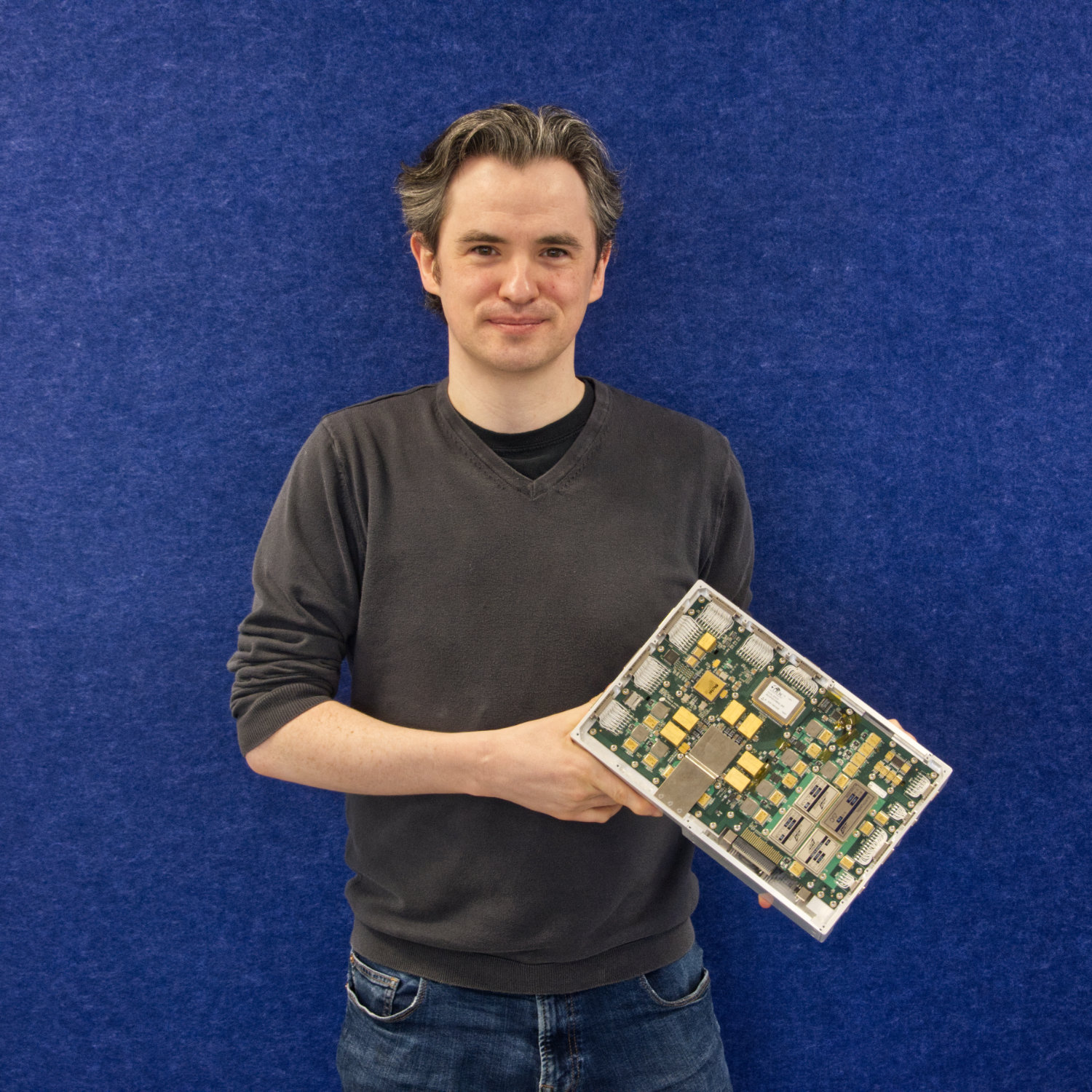
“EMIT consists of a state-of-the-art imaging spectrometer capable of investigating visible and infrared spectra to determine the makeup of mineral dust clouds. It will fill a critical gap in our understanding of Earth’s atmosphere and factors driving climate change,” says David Dolman (pictured), Senior Design Engineer for FPGAs, Electronics and Software. “This instrument sets a new standard in high-performance onboard processing – in compression and cloud screen – as well as storage of data.”
The FPIE-D (Focal Plane Interface Electronics – Digital) provided by Alpha Data plays a critical interface role between the spectrometer, the ISS and ground teams. Scanning continuously over 328 spectral bands, Alpha Data’s FPIE-D can handle high data rates whilst operating in a hostile, high-radiation environment. The electronic module digitises, stores and relays detailed images of target regions, built up as the orbit of the ISS crosses an area of interest.
The high-performance FPIE-D hardware was designed and its manufacture managed by Alpha Data in Colorado, the US, while the software and firmware that runs and configures the Adaptive SoC FPGA based system was developed by Alpha Data specialists in Scotland. The EMIT FPIE-D design is based on a standard Xilinx Zynq7100 board in an XMC form factor. This is an off-the-shelf board that Alpha Data customised for space and its specific mission. It also required that several components are replaced with space-grade equivalents.
The FPIE-D board is reprogrammable, radiation-tolerant kit, suitable for a variety of demanding uses with stringent certification processes, ranging from laboratory conditions to long-term operation in Earth orbit.