
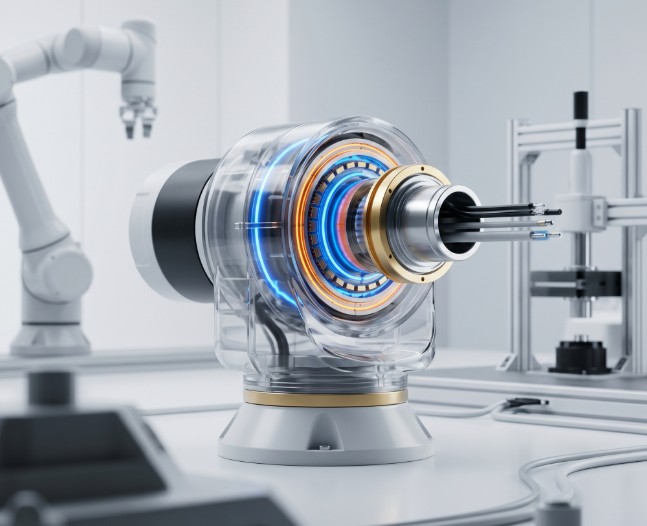
RLS has expanded its magnetic encoder portfolio with the launch of the AksIM-4 Dual Concentric, an ultra-thin absolute encoder designed to provide simultaneous motor-side and joint-side position feedback from a single coplanar package. The technology is now available through Astute Group and will be showcased alongside RLS at Hardware Pioneers Max 2026.
According to RLS, the new encoder integrates two independent absolute encoders within a single ultra-thin off-axis architecture. The design addresses a longstanding challenge in robotic joints, where separate encoders are typically required to measure motor rotation and the actual output position after a gearbox or reducer.
As robotic systems become more compact, particularly in collaborative robots, humanoid platforms and medical robotics, available space inside joints continues to shrink. RLS states that AksIM-4™ Dual Concentric was developed specifically to “deliver motor and joint position feedback in one ultra-thin, two-in-one encoder”, helping designers reduce component count and simplify integration.
—> Explore the RLS product portfolio and discover how we can support you
Combining Motor and Joint Feedback on a Single Ring
Traditional robotic joints often require two encoder systems mounted at different locations within the assembly. This increases mechanical complexity, adds cabling, and consumes valuable installation space.
The AksIM-4™ Dual Concentric places both feedback systems onto a single flat-ring structure, allowing motor and output position measurements to be captured within the same footprint. The result is fewer components, reduced assembly complexity and lower overall joint weight.
For OEMs developing robotic arms, surgical systems and precision automation equipment, reducing encoder count can also simplify procurement, inventory management and assembly processes.
The design retains the through-bore architecture associated with the wider AksIM family, enabling engineers to route power cables, data harnesses, pneumatic lines, cooling circuits or vision-system wiring directly through the centre of the joint without compromising position feedback performance.
High-Resolution Absolute Position Feedback Without Optical Components
Position accuracy remains a critical requirement in advanced motion control systems.
RLS’s magnetic encoder technology provides true absolute position measurement without relying on optical discs or batteries. Existing AksIM architectures support resolutions up to 20 bits and immediate position availability following power-up, eliminating homing procedures and reducing machine start-up times, according to an industry report covering the AksIM platform by AutomationTR.
The magnetic sensing approach also removes many of the environmental limitations associated with optical encoder technologies. Dust, oil, moisture and vibration have minimal impact on encoder operation, making the technology suitable for industrial automation, autonomous systems, medical equipment and outdoor motion-control applications.
As demand grows for compact robotic joints with higher torque density and increased sensing requirements, integrated feedback architectures are becoming increasingly important. Mechanical designers are being asked to fit more functionality into smaller spaces while maintaining reliability and serviceability.
Meet Us at Hardware Pioneers Max 2026
Astute and RLS will be demonstrating the latest magnetic position feedback technologies, including the AksIM-4™ family, at Hardware Pioneers Max 2026 at ExCeL London on 10–11 June 2026.
The event will provide visitors with access to RLS encoder specialists and Astute’s technical team to discuss robotic motion control, precision positioning, integration challenges and long-term component availability. Event details and meeting bookings are available here.
RLS describes the new device as helping manufacturers “reduce component count, simplify cabling, and design smaller, more efficient joints”. The launch reflects increasing demand for integrated sensing technologies capable of supporting the next generation of robotics, collaborative automation and precision medical systems.
As robotic platforms continue to move towards higher levels of integration, encoder architectures that reduce footprint while maintaining absolute position accuracy are expected to become a larger part of future motion-control designs.