In the world of semiconductors, “authenticity” is the foundation of safety. But a deepening internal schism between the Dutch headquarters of Nexperia and its Chinese operating unit has shattered that foundation, creating a quality crisis that is currently rippling through the industrial and automotive sectors.
At ASC Global, our Q1 2026 analysis indicates that what began as a corporate payment dispute has evolved into a full-scale governance breach, leaving global OEMs to grapple with the rise of “pseudo-Nexperia” components that may lack the rigorous qualifications required for modern vehicles.
The crisis reached a breaking point in late 2025 when Nexperia took the unprecedented step of halting all wafer shipments from its Hamburg, Germany, fab to its primary assembly facility in Dongguan, China, which is responsible for 70% of Nexperia’s total global output.
The cause was twofold: a dispute over a $137m debt and reports that local Chinese management had misappropriated corporate seals to operate as a “rogue” entity independent of Dutch oversight.
Deprived of authentic European silicon, the Chinese unit has reportedly pivoted to local domestic foundries to maintain operations. This has forced Nexperia HQ to issue a warning to the global market: it can no longer guarantee the authenticity, intellectual property, or quality standards of any components processed in China after mid-October 2025. Nexperia HQ has officially warned that it cannot guarantee the quality or authenticity of any parts processed in China after mid-October 2025 due to parts processed in China lacking official HQ validation and potentially not meet AEC-Q101 automotive safety standards.
For the automotive industry, the implications are severe. Unauthorised local wafers often lack the AEC-Q101 automotive-grade qualifications inherent in the original German silicon. We are now seeing “pseudo-Nexperia” parts – domestic Chinese wafers packaged in Nexperia-branded housings – entering the spot market without HQ validation.
The industry response has been swift and defensive: Tier-1 automotive giants like Bosch and Continental have reportedly halted intake of China-originated Nexperia lots pending exhaustive lab verification. And as buyers flee China-sourced inventory, prices for “Western-validated” Nexperia stock have surged by 400% on the spot market.
In a desperate bid to restore supply integrity, Nexperia is fast tracking a $300m expansion in Malaysia and the Philippines, aiming to move 90% of its global capacity out of China by mid-2026.
What once was a lead time of 8-12 weeks for these parts (Q1-2024), now (Q1-2026) is unpredictable.
Until governance is restored, the industry must treat China-sourced Nexperia lots as a high-risk category. For high-reliability designs, the transition to second-source equivalents from providers like Onsemi, STMicroelectronics or Infineon is no longer a suggestion but a necessity for maintaining the safety and integrity of the global supply chain.
The 2026 memory shortage is different
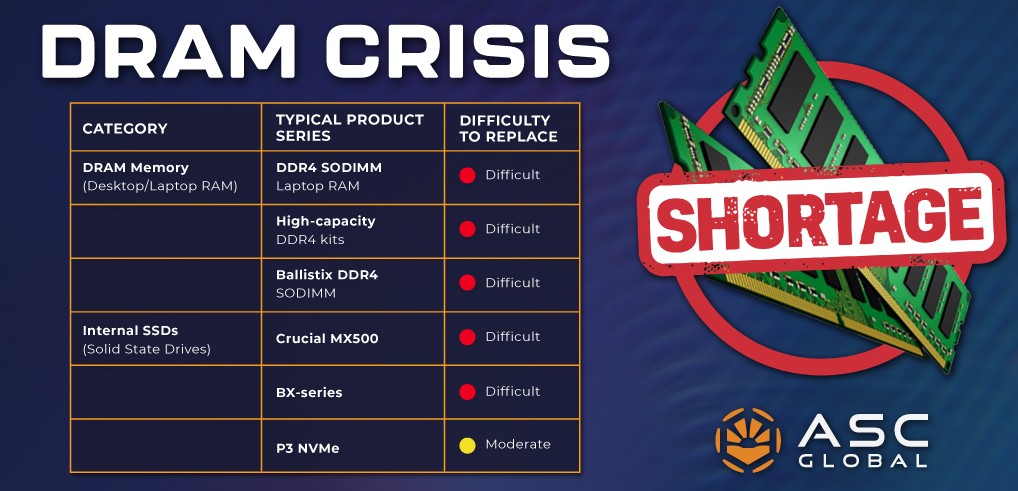
In addition to market disruptions affecting the market, such as those of Nexperia, sectors like AI data centres are further straining the semiconductor market. The semiconductor industry has entered a new, more volatile era. While the global supply chain disruptions of the early 2020s were defined by “clogged ports and empty shelves”, the crisis of 2026 has taken on a different guise – and far more fundamental. We are no longer facing a logistics problem; we are facing a “Memory Supercycle” fuelled by the insatiable appetite of AI.
At ASC Global, our Q1 2026 market analysis reveals a stark reality: the world’s manufacturing capacity is being reallocated at an unprecedented rate. To feed the demand for AI infrastructure, major fabs have pivoted away from the conventional memory (DDR4 and DDR5) that power laptops and vehicles, instead focusing on High Bandwidth Memory (HBM) and enterprise-grade SSDs.
The most visible casualty of this shift is the retail consumer. In a move that signalled the end of an era, Micron recently announced the complete dissolution of the “Crucial” brand – a staple for PC builders for decades. By reallocating 100% of retail wafer starts to HBM4 and enterprise production, Micron has effectively exited the DIY market.
This isn’t an isolated incident. With SK Hynix reporting that its 2026 capacity has already “sold out” and Samsung raising contract prices by as much as 60% to meet AI-driven margin targets, the retail and “non-enterprise” sectors are being crowded out. We project that average selling prices for PCs will jump 8% this year, potentially shrinking the global PC market by 9% as manufacturers struggle to absorb these costs.
And this impact extends far beyond the home office. The automotive and industrial sectors are facing a “double threat”. Manufacturers are retiring older memory nodes (DDR4/LPDDR4) faster than the automotive sector can redesign its long-cycle systems. These high reliability, low-volume parts are now competing for the same silicon wafers as high-margin AI chips, which results in price increases of nearly 70% for automotive-qualified DRAM.
This is bringing “panic buying” and “double ordering” reminiscent of 2021. Hyperscalers like Meta, Google and AWS have adopted “open-ended” procurement strategies – essentially buying every available chip regardless of price. This leaves smaller OEMs and Tier-2 data centres in a precarious position, forced to prioritise continuity of supply over price optimisation.
The road ahead: 2026-2027
The consensus among analysts is clear: supply will remain structurally tight through at least 2027. Whilst new fabrication plants are under construction in Texas, US, and South Korea, they will not offer relief for the current fiscal year.
For the next 18 months, the industry must brace for a “bullwhip effect”. The priority for any business reliant on silicon is no longer “How much does it cost?” but “Can we get it at all?”
As AI continues to reshape the global economy, the memory shortage is the first major tax on that progress. One that every consumer and corporation will eventually have to pay.
By Mairo Gaete, CEO, ASC Global