Fibre optic connectivity is found in many applications, one of which in data-centre fibre installations but also in more demanding, harsh environments like the military and aerospace. In these environments, fibre must be carefully installed, in a regulated and protected operating environment.
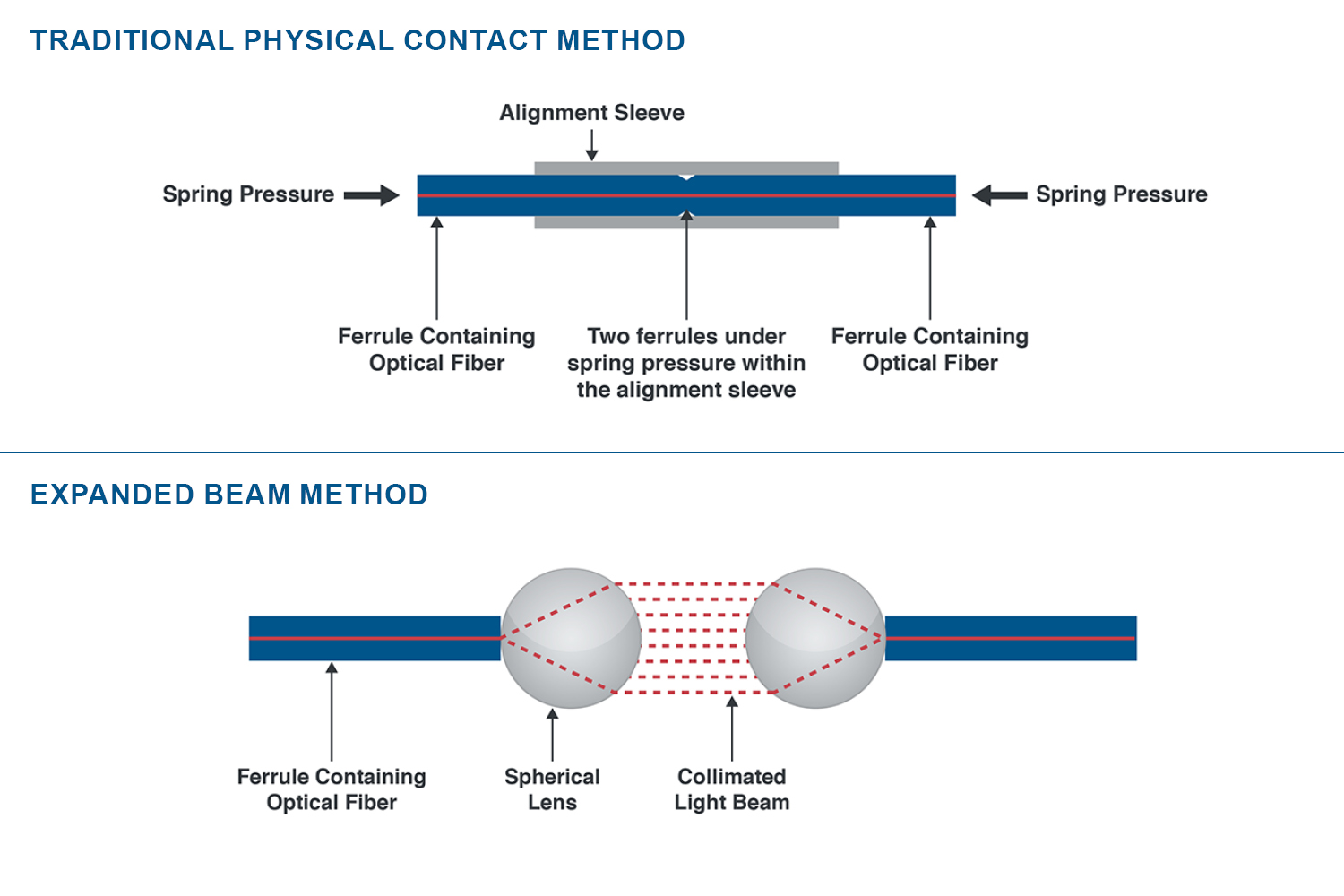
In data centre applications, a popular fibre connectors are the LC, SC, ST and multi-fibre MPOs types, which use highly polished physical contacts with very small diameter fibres core of under 50 microns. The contact accurately and physically butts against a polished end of the mating fibre, to provide a near invisible joint with minimal transmission loss and offer excellent performance and reliability. The light-transmitting fibre core needs to align perfectly with the connected fibre core to avoid transmission problems. Without sealing or protection, the very small size means it will be very sensitive to any dirt or moisture that might contaminate the end of the light-transmitting fibre.
Connectors for harsh environments
In applications like avionics and the military, environmental conditions are even tougher, and require reliable, secure, performance-critical data-based communication systems, which calls for ruggedised connectors. It is essential that the optical contacts remain protected and, in general, a modified fibre-optic connector technology is used to deliver a level of reliability that fibre connector types like LC, SC, ST and multi-fibre MPOs cannot match.
In addition to military and aerospace applications for tactical communications and battlefield networks, other typical applications include oil and gas for downhole drilling, subsea communication and pipeline monitoring, industrial and transportation, railway signalling, automation and heavy machinery, medical and scientific imaging systems, sensors and diagnostics in demanding settings.
In these domains there will be different approaches to help provide this extra resilience, essentially these can be grouped into two main criteria:
- adding mechanical and environmental protection to the connector system through seals and materials, and
- expanded beam technology. Different construction of the connector type allows these additional features to be introduced and has resulted in a number of different connector series which are now the go-to solution.
The first approach is perhaps the most obvious and easily understood. Adding protection to light-transmitting fibre ends will prevent possible degradation and failures of the system through dust or moisture. For use in harsh environments, these features most typically appear as metal connectors bodies and elastomeric seals which become compressed through joining two connector halves together. The metal construction adds considerable mechanical strength and selection of materials like aluminium, bronze and stainless steel can then address specific performance needs like chemical resistance and salt-spray corrosion. Environmental seals add reliable protection when mated or sealed protective covers will provide the same when the connectors are not in use. When added shock and vibration become additional considerations, some of the higher-reliability solutions will provide additional alignment features which take any mechanical stresses away from the light-transmitting fibre contacts, extending operational life and reliability.
Approved for military use
A good example of this approach would be the EATON Souriau range of connectors fitted with high-reliability ELIO fibre-optic contacts. The 8D range in particular is based a popular derivative of the military-proven MIL-DTL-38999 circular connector style. The connector construction provides comprehensive sealing when mated and the circular metal shell can be specified in aluminium, composite, marine bronze and stainless steel with a range of different plating finishes. The single-mode and multi-mode ELIO fibre-optic contacts use a robust 2.5mm ferrule with precision alignment to provide performance and resilience under high levels of shock and vibration.
Features to look for in fibre-optic connectors for rugged applications:
- Low insertion loss to ensure minimal signal loss (typically <0.5 dB for physical contact connectors and <1.0dB for expanded beam).
- High return loss in order to reduce signal reflections and maintain data integrity.
- Shock and vibration resistance: Connectors must meet military and industrial standards (e.g., MIL-DTL-83526) to withstand mechanical stress.
- Impact Protection: Use of reinforced housings to prevent damage from physical impact.
- Wide operating temperature range, typically -55°C to +85°C.
- IP67 or IP68-rating for protection from wate and environmental conditions.
- Stainless steel or composite plastic materials to resist exposure to fuels, oils, and other harsh substances.
Expanded beam technology
Another approach in these applications is expanded beam technology which uses two matching lenses, one at the end of the transmitting fibre from which the light beam is emerging, and the other at the end of the fibre it is being connected to. The first lens expands the emerging beam and the second lens than refocuses the light, reconstructing a beam in the second fibre of the same size of the original beam. As the beam of light passing between the two lenses is expanded to have a much larger diameter than the beams inside the fibres, this means that any particle of dust or dirt will be a much smaller proportion of the transmitted light beam, and it therefore has less effect on blocking the light and affecting the signal.
Specifically designed expanded beam connectors incorporate this lens technology within each mating half. Unlike physical contact technology, the expanded beam connection is contactless, with the expanded light beam passing over a small gap between the two lenses within the connector system once mated. This significantly improves resistance to vibration and mechanical wear and can increase the reliability and lifetime of the connector. The air gap also means that any dirt or contamination on the lenses will not damage the mating half in use. A good test for expanded beam connectors that are designed for harsh environments is to drop disconnected connectors in dirt, then rinse them off with water or wipe with a cloth and then mate them – a good connector system should not be affected and work straight away, every time.
A good example of expanded beam technology would be the CINCH Fibreco Junior range of connectors. Derived from the military-proven MIL-DTL-83526 connector style, featuring sealed single-mode and multi-mode expanded beam inserts within a fully sealed hermaphroditic circular metal shell. The circular metal shell can be specified in aluminium, marine bronze and stainless steel with a range of different plating finishes. All Cinch expanded beam connectors are designed to perform well under harsh conditions and in addition to the robust materials and secure construction, every Fibreco expanded beam connector insert utilises a unique, patented optical arrangement, whereby the critical interface between the optical fibre and the lens is permanently sealed in a controlled atmosphere during manufacture. This ensures that no dust, moisture, or other contaminants can migrate into the optical path within the connector insert during the product’s life.
Major benefits of expanded beam connectors include:
- Use of lenses to widen the optical signal, reducing sensitivity to dust and misalignment.
- Different polishing techniques improve performance based on application needs.
- Combining electrical and optical connections in one multi-channel rugged assembly.
- Ease of Installation and Maintenance
- Possibility of field-termination and repair.
- Quick connect push-pull or bayonet coupling design to facilitate rapid deployment.
Comprehensive portfolio
Franchised distribution partner, Lane Electronics service existing and new Cinch Fibreco customers throughout the EMEA region using our in-house stock of connectors and UK-made value-added cable assemblies via accredited Fibreco termination specialist, Weald Electronics, and back-to-back supply directly from the Cinch facility where required. In addition to an extensive range of expanded beam connectors, Lane Electronics brings together a comprehensive portfolio of high-performance, high-reliability fibre-optic connectors from leading manufacturers EATON Souriau and HUBER+SUHNER and supporting accessories such as backshells, protective covers and deployable cable reels to suit both large and small production volumes. They offer high performance, flexible, cost-effective connectivity solutions for critical data communication applications in harsh environment such as defence, aerospace, security, offshore, mining, outside broadcast and other industrial applications, with enhanced availability via a comprehensive on-line store providing around-the-clock accessibility.
By Phil McDavitt, Strategic Business Manager, Lane Electronics