
Many industry experts and even some electronics manufacturers make bold predictions that 8-bit microcontroller units (MCUs) will disappear; but, is this likely?
On to 32-but MCUs?
Since the 1970s, 8-bit MCUs have been widely used in consumer and industrial applications, and most analysts forecast that we will see their continuous growth well into the next decade. Today these devices are even smarter and more capable than ever, finding place in nearly every system – from automotive and industrial to consumer and medical.
Naturally, we’d assume that an increase in distributed intelligence in smart devices and systems would be better served by 32-bit MCUs, but let’s not be so hasty. The bit size in an MCU is important, but there are also other factors to consider. Today’s 8-bit MCUs are a lot more powerful and sophisticated, and can easily cater for modern applications. In fact, they are often the best solution for systems that need compactness, cost-effectiveness and energy efficiency. They are also advantageous in applications that require substantial computational power and many peripherals. As co-processors they effectively off-load tasks from central processors, for system efficiency. For example, 8-bit MCUs can be used to pre-process analogue signals in sensor nodes, reducing the amount of data sent to the central processor.
Wide-range applications
In automotive, distributed intelligence has experienced a remarkable surge, resulting in smarter and more advanced vehicles. A significant factor behind this increase in functionality is the industry’s move from mechanical-based subsystems to networked electrical set-ups.
Modern vehicles consist of many individual subsystems or zones, interconnected and overseen by larger electronic control units (ECUs). At the heart of any subsystem are MCUs, controlling individual functions and modules such as lights, actuators, power fold mirrors, steering wheel buttons, switchgear – to name just a few. Using 8-bit MCUs to control these peripherals can reduce system overheads and complexity, by allowing localised processing and basic decision making, as well as removing the need to relay everything back to the ECU. Although there are many MCU options to power these modules, 8-bit MCUs are often the best choice.
The demand for 8-bit MCUs is fuelled by distributed intelligence in industrial applications also. Having an MCU in a networked edge node minimises the volume of data that is shifted across the network, reducing bandwidth requirements and the central processor’s workload. For example, instead of connecting several sensors to a single central processor, a much more efficient way is to add a small and cost-effective 8-bit MCU at each node, enabling communication with the main processor only when necessary.
Without this modular approach, many modern automation and robotic applications simply wouldn’t be possible. The sheer volume of data produced by motors, actuators and sensors can lead to unworkable network traffic, incredibly complex code and drastically increased demands on the central processor. Equally, from a design standpoint, because industrial applications can be very diverse in function and large in scale, engineers must treat individual functions as unique modules.
Beyond industry and automotive applications, 8-bit MCUs are also seeing an increased demand in the Internet of Things (IoT) and the Internet of Medical Things (IoMT). Whether we are talking about modern wearables and health trackers or thermostats and smart speakers, all solutions are reliant on data collection, intelligence and wireless communication, whilst demanding low-power operation.
What is clear from talking to electronic engineers and manufacturers like Microchip is that not only is the decline of 8-bit MCUs far from imminent, but there will probably be novel 8-bit offerings to emerge yet.
Microchip’s MCUs
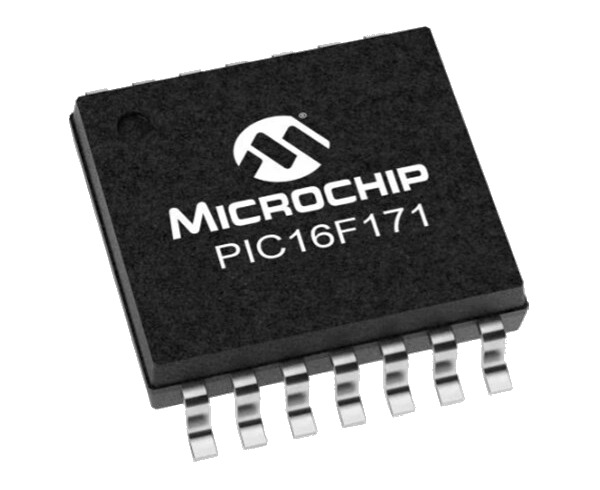
One company synonymous with 8-bit microcontrollers is Microchip Technology, having released its first 8-bit MCU in 1976 – the PIC1650. Microchip’s 8-bit MCU portfolio has significantly expanded since then, with added functionality and abilities, allowing more systems to make the most of PIC and AVR MCUs, including the PIC16F171 (Figure 1) and AVR64DD32/28 ranges. These ranges feature on-chip Core Independent Peripherals (CIPs) and integrated advanced analogue processing, making designs more efficient and requiring lower power. The inclusion of CIPs and common analogue modules offer further versatility and a unique level of configurability to system designers, allowing the development of efficient programs with minimal code overhead, and to create designs with compact packaging, with lower overall bill of materials.
The simplicity and efficiency of 8-bit PIC and AVR MCUs make them preferred in vehicle subsystems, keeping the designs compact, and providing the low-power operation that is often sought in modern electric vehicle applications. Microchip has further tailored its solutions for the automotive market by integrating a Controller Area Network (CAN) bus into its automotive 8-bit microcontroller range.
By Mark Patrick, Technical Content Director, Mouser Electronics