By Tony Ingham, Sales and Marketing, Sensor Technology
Television and film’s increasing reliance on computer-generated imagery (CGI) has upped the ante for stage-set designers, who sometimes have to work in front of live studio audiences, in restricted spaces and with a constant eye on the safety of the many people working on the set.
Many stage props and almost all of the backdrops are lowered onto the stage from the fly tower behind it. This is usually done quickly between or during scenes, requiring utmost safety and reliability.
Until recently, the sets were manually controlled, with a technical stage manager supervising from the wings, and giving instructions by radio to the winch orators, making sure nothing fails – in the process damaging the set or injuring a person. To guarantee safety and reliability, Sensor Technology is using real-time load signals from each winch, with their data being monitored by a computer, so that instant action can be taken if any loads move out of tolerance.
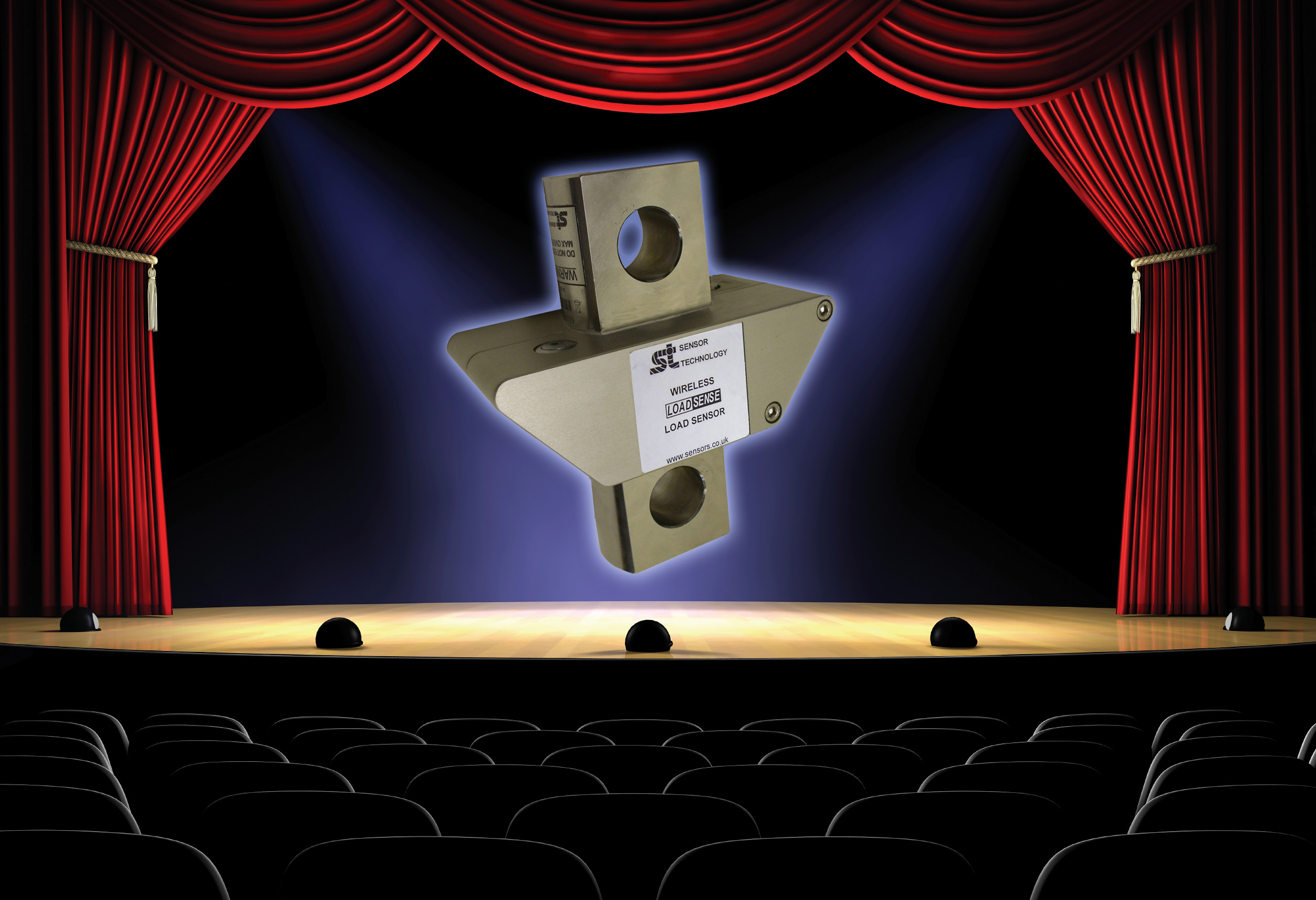
LoadSense
Originally, Sensor Technology developed the load cells called LoadSense for monitoring cargo nets carried under helicopters; now they have found their way in film sets and theatres. The load cell for theatre applications was customised, with a robust, industrial-grade wireless communication. Each LoadSense has an on-board RF transmitter that sends signals to a control room computer. The transmitter must be robust, to cope with the environment it is in, and maintain signal integrity through the most corrupting of harmonic conditions.
Working in real time, any problems are instantly flagged and addressed. For instance, if a load starts running too fast, it could be immediately slowed. If a prop is heavier than expected, this could suggest someone was standing on it, so it shouldn’t be whizzed 50 feet into the air at high speed. In this case, the computer ‘jiggles’ the load for a second or two as a warning to encourage the person to step away. If the load then returns to normal, it will be allowed to rise again; if not, the floor manager is alerted by an alarm to check the situation.
LoadSense is proving so sensitive that it can provide a feedback signal to close the control loop on a vector drive that controls the winch. Normally, theatre engineers use sensorless vector drives, which offer good dynamic performance without the complications of wiring in a feedback sensor. Sensor Technology is closing that loop, which improves system integrity and enhances safety by a significant margin.
Good for big sets
Not that long ago, stage scenery was fairly static, being moved only during the interval when curtains were closed. But, West End and Broadway theatres then started to emulate some of the setups used in film sets, which brought on requirements for customisation of setups.
In some ways, today, theatre engineers work in more demanding conditions than manufacturing engineers. Everything has to be right on the night in theatres, harmonic corruption is at stratospheric levels, there can be major changes at a moment’s notice, and people run through the ‘machinery’ without a thought for personal safety, among the many other challenges.
Also, theatre engineers would not be able to achieve half of what they do without wireless communications; there would be too many wires all over the place that could inevitably bring problems, such as being broken or disconnected at the most inopportune of moments.