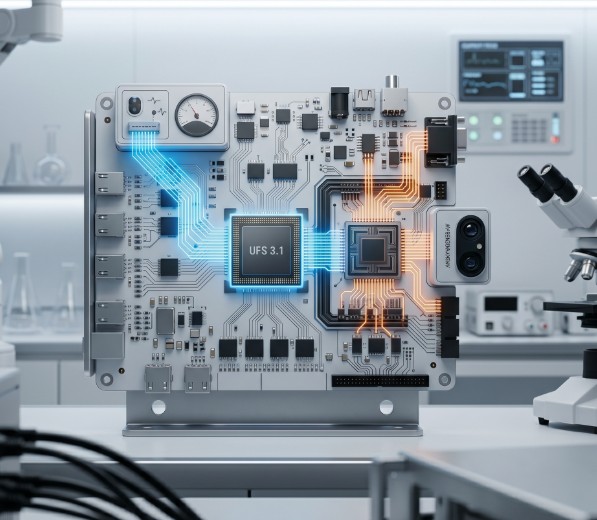
Intelligent Memory has introduced a new range of UFS 3.1 managed flash devices aimed specifically at embedded, industrial and automotive applications, combining capacities up to 512GB with extended lifecycle support and industrial-grade reliability in a compact 11.5 x 13 mm BGA153 package. According to StorageNewsletter, the portfolio is available in 128GB, 256GB and 512GB capacities and delivers sequential read speeds of up to 1,700MB/s and sequential write speeds of up to 1,480MB/s.
The launch arrives as manufacturers face growing storage demands from autonomous systems, industrial edge AI platforms, machine vision equipment and connected medical devices. These applications increasingly require rapid data access, higher endurance and lower power consumption while maintaining production continuity across product lifecycles that often exceed a decade. Intelligent Memory remains one of the few suppliers actively supporting industrial-grade memory products in densities and formats that many high-volume manufacturers have discontinued.
UFS 3.1 Gains Momentum in Industrial and Automotive Markets
The transition from eMMC to UFS has accelerated as embedded systems process larger datasets and support more advanced software workloads. According to Samsung Electronics, automotive UFS 3.1 devices are increasingly being deployed in applications such as in-vehicle infotainment, ADAS and autonomous vehicle platforms, where storage bandwidth and power efficiency directly affect system performance.
Intelligent Memory’s latest devices target similar requirements across industrial automation, smart cameras, edge computing and embedded AI platforms. The company states that the new products offer substantially higher throughput than legacy eMMC solutions, enabling faster boot times and improved responsiveness in data-intensive environments.
Alistair Jones, Global Director of Sales and Marketing at Intelligent Memory, said: “Most industrial designs simply don’t require high-density storage”, as reported by CIE.
He added: “With our new low-density eMMC portfolio, customers get precisely the capacity they need, without paying for excess. We’re committed to supporting these products for the long term, providing peace of mind through a stable and predictable supply chain.”
Addressing the Industrial Lifecycle Challenge
A recurring issue across embedded markets is the mismatch between consumer technology refresh cycles and industrial product lifespans. Consumer storage technologies frequently change every two to three years, while industrial and automotive programmes often remain in production for more than ten years.
Intelligent Memory’s new UFS range has been developed with long-term availability and continuity of supply as core requirements, alongside support for standard, industrial and automotive temperature grades. The devices also support both 2.5V and low-voltage 1.2V operation for power-sensitive designs.
This focus on lifecycle management reflects a broader trend across the memory sector, where sourcing stability has become as important as raw performance.
Hardware Pioneers Max 2026 Showcase
Intelligent Memory’s UFS 3.1 portfolio will be showcased alongside Astute Group at Hardware Pioneers Max 2026 in London on 10-11 June.
Astute and Intelligent Memory will be available for technical discussions covering memory selection, lifecycle planning and long-term supply strategies for embedded and industrial applications.
Manufacturers evaluating storage architectures for future edge AI, industrial automation, medical and automotive platforms can meet with Astute’s technical specialists during the event to discuss UFS 3.1 deployment, lifecycle support and broader memory roadmap requirements.